Hosted PBX vs Onsite PBX: Which Fits?
A clear, honest breakdown of cost, reliability, flexibility, security, and support, so you can choose the phone system that actually fits how your team works.
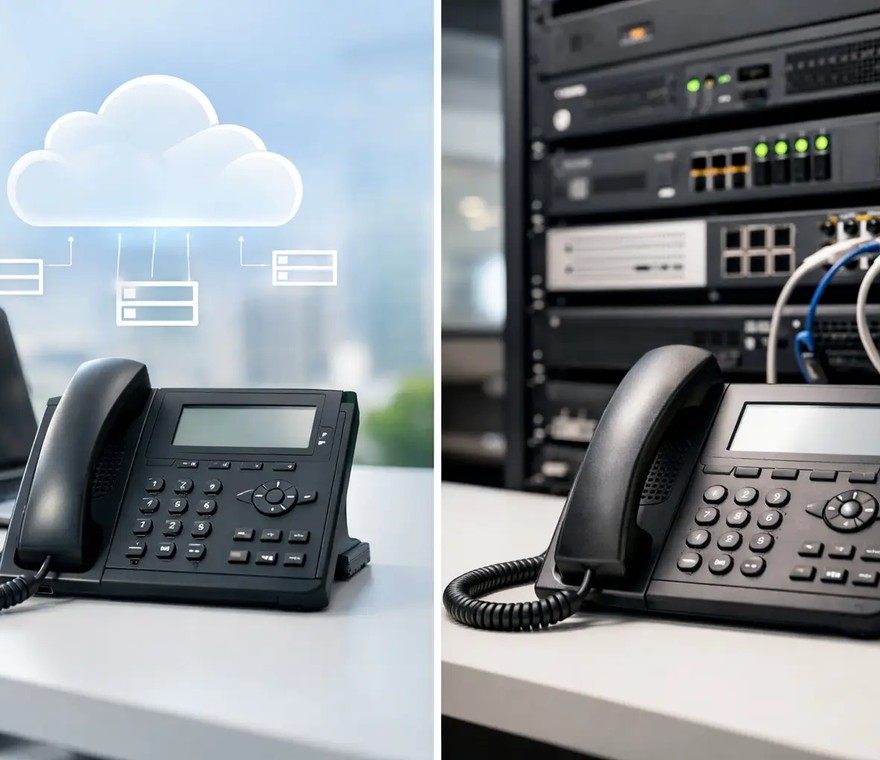
If your phone system still depends on a box in a back closet, this choice matters more than most providers admit. Hosted PBX vs onsite PBX is not just a telecom decision. It affects your monthly costs, how fast you can add users, what happens during an outage, and who gets the call when something breaks.
For most small and mid-sized organizations, the straight answer is simple. Hosted PBX usually makes more sense. But there are still cases where an onsite system is the better fit, especially if you have unusual security rules, sunk hardware costs, or a very specific internal IT setup. The right choice depends on how your team works day to day, not on which acronym sounds more familiar.
Hosted PBX vs onsite PBX: the real difference
A PBX is your business phone system. It handles call routing, extensions, voicemail, auto attendants, ring groups, and all the things that make a company phone setup work like a company instead of a few random cell phones.
With an onsite PBX, the equipment lives in your building. Your organization buys and maintains the hardware, and your calls depend in part on what is happening at your location.
With a hosted PBX, the system is run in secure offsite data centers and delivered over your internet connection. Your users still get desk phones if they want them, but they can also take calls on a laptop or mobile app. The provider manages the core system, updates, redundancy, and maintenance.
That distinction changes almost everything that follows.
The short version
Before the details, here is the shape of the decision.
Hosted PBX
- Monthly per-user pricing, no large upfront hardware buy
- Provider handles redundancy, maintenance, and upgrades
- Built for remote, hybrid, and multi-location teams
- Scales up or down in minutes, not projects
- Best fit for most small and mid-sized organizations today
Onsite PBX
- Larger upfront cost, direct hardware ownership
- Your team owns patches, failures, and replacement cycles
- Resilience during outages depends on your own backup plan
- Can still make sense with strict internal IT requirements
- Best fit when connectivity or legacy systems are limiting factors
Cost looks different than people expect
An onsite PBX often feels familiar because you buy the system and keep it in-house. But the upfront cost is usually the first surprise. Hardware, licensing, installation, handsets, maintenance contracts, and future upgrades add up quickly. If you need to replace aging lines or add capacity, the bill can rise again.
Hosted PBX shifts that model. Instead of a large capital expense, you typically pay a monthly per-user fee. For many businesses, that is easier to budget and much easier to scale. You add a user, remove a user, or bring on a new location without replacing the whole phone system.
That does not mean hosted is always cheaper in every scenario. If a company already owns a newer onsite system outright and has internal staff who can support it well, keeping it a while may be financially reasonable. But for organizations comparing a fresh purchase to a hosted service, hosted PBX usually wins on total cost and flexibility.
This is especially true for schools, local governments, and multi-location businesses that need predictable monthly spending. Surprise repair bills are hard enough. Few teams want to budget for a failed server card too.
The cost that rarely makes the budget conversation
There is also a cost that rarely makes it into the phone system budget conversation at all: the cost of the phones simply not working. Research on unplanned outages consistently finds that even small businesses, those under 25 employees, can lose more than $1,600 a minute when critical systems, including phones, go down, once you count idle staff time, missed calls, and lost business. A dropped phone system rarely shows up on a repair invoice the same way a dropped server does, but the business impact is real either way.
Reliability is about more than where the box sits
Some buyers assume onsite means more control and therefore better reliability. That can be true in a narrow sense. If the equipment is in your building, you know exactly where it is. But you also inherit the risks that come with that setup.
If the office loses power, floods, or has an internet or wiring problem, your phone system can go down with it. You may be able to add battery backup or generator support, but now you are building your own resilience plan.
A hosted PBX puts that burden on the provider. The question becomes whether the provider has real redundancy or just marketing language. You want to know where the data centers are, whether there is backup power, whether they test it, and whether traffic can fail over automatically.
That matters a lot in places where storms, utility issues, and local outages are part of doing business. A hosted system backed by multiple data centers and diverse network paths can keep your calls moving even when one site has trouble. Your office may be closed, but your team can still answer calls from another location, from home, or from a mobile device.
For many organizations, that kind of continuity matters more than owning the hardware. It is one reason Carolina Digital Phone runs on geo-redundant infrastructure with a 99.99% uptime target rather than a single data center. Redundancy is not a feature you bolt on later. It has to be part of the platform from day one.
Hosted PBX is usually better for modern work
Most businesses do not work from one front desk and a row of offices anymore. People move between job sites, branches, home offices, and their cars. Reception may sit in one town while accounting sits in another. That shift is one reason hosted systems have become the default choice for so many organizations.
The numbers back this up. As of early 2026, roughly 22.6% of U.S. employees work remotely at least part of the time, and among workers whose jobs can be done remotely, more than half work a hybrid schedule rather than five days at a single desk. A phone system tied to a single building's wiring closet was not built for a workforce that moves like that.
A hosted PBX is built for that kind of flexibility. Your main number can ring a desk phone, a computer app, and a mobile device. Calls can be routed by schedule, department, or location. Voicemail can arrive in email. Staff can transfer calls or check messages without being tied to one building.
An onsite PBX can support some of this, but it often takes more configuration, more add-on tools, or more IT involvement. What feels manageable at 20 users can become a headache at 80, especially across multiple sites.
That is why hosted PBX tends to fit healthcare offices, law firms, property managers, schools, and construction companies especially well. These teams need calls to follow people, not just desks.
Control and customization still matter
This is where onsite PBX keeps a real argument. Some organizations want direct ownership and deeper internal control over the phone environment. If you have in-house telecom expertise, strict network segmentation requirements, or systems that are tightly tied to legacy equipment, onsite may still be the cleaner path.
There are also cases where a facility has unreliable internet and no realistic way to improve it yet. In that setting, depending fully on a hosted service may not be the right move until connectivity is fixed.
That said, many buyers overestimate how much control they actually want. Owning the box also means owning patches, hardware failures, software compatibility, backups, and replacement cycles. For a busy office manager or lean IT team, that is often not control. It is one more thing sitting on the problem list.
Security and compliance are not automatic either way
Some people hear "cloud" and worry about security. Others hear "onsite" and assume it is safer because it is local. Neither assumption is reliable on its own.
Security depends on how the system is designed, managed, patched, and monitored. Compliance depends on whether the provider or internal team understands the rules that apply to your organization. If you are in healthcare, education, or government, those details matter.
Emergency calling is not optional
Under FCC rules, every interconnected VoIP provider is required to support Enhanced 911, meaning your registered address is transmitted automatically when someone dials 911 from your system. Federal law, specifically Kari's Law and the RAY BAUM'S Act, also requires that multi-line systems allow direct 911 dialing with no prefix and notify an on-site contact when a 911 call is placed. A hosted provider should be able to walk you through exactly how they handle this, not just point to a compliance checkbox.
A hosted provider should be able to explain how it handles call security, user access, E911, and any HIPAA-aware or caller authentication requirements that apply. An onsite system may give you more direct custody, but it also puts more of the compliance burden on your team.
The right question is not whether hosted or onsite is automatically safer. The right question is who is better equipped to manage the risk well.
Support is where the gap gets obvious
Phone systems are easy to love when everything works. The real test is what happens when your front desk cannot transfer calls, a location loses service, or you need to reroute numbers before the workday starts.
With an onsite PBX, support often means a mix of vendors, installers, carriers, and internal staff. That can work, but it can also create finger-pointing. One says it is the phone system. Another says it is the network. Meanwhile, your calls are still not landing where they should.
With a good hosted provider, support is simpler. One team knows the platform and can make changes quickly. That matters even more for organizations that do not have a full-time telecom specialist.
This is one place where a local provider can make a real difference. A business in North Carolina, South Carolina, or Virginia may not need the biggest brand name. It may need a provider whose engineers answer the phone, know the setup, and can fix the issue without sending you into a call-center maze.
That is the model Carolina Digital Phone has run on for more than 25 years. Every hosted PBX migration starts with a pre-sales engineer mapping your actual call flow, not a generic template, and it does not stop at go-live. Our team keeps refining routing, adding tools, and answering the small questions right alongside the big rollouts, whether that is porting a single number or standing up a multi-location system for a school district or county office.
So which one should you choose?
If you are replacing an aging phone system, adding remote or mobile users, opening another location, or trying to lower telecom costs, hosted PBX is usually the better answer. It is easier to scale, easier to manage, and generally better aligned with how people work now.
If you already have a strong onsite investment, unusual technical requirements, or a facility where internet constraints are still unresolved, onsite PBX may still make sense for now. Not forever, maybe, but for now.
A good provider will tell you that honestly. At Carolina Digital Phone, that means starting with how your phones are used, where your staff works, what downtime costs you, and how much support you really want to own. That is a better starting point than debating hardware on principle, and it is the same conversation we have been having with businesses, schools, and government offices across the Piedmont Triad for more than 25 years.
The best phone system is the one that keeps your calls answered, your staff reachable, and your business moving when the day does not go as planned.
Ready to find out which fits your team?
Talk to a local North Carolina engineer, no pressure, honest pricing, and a straight answer, even if that answer is "stick with what you have for now."
Talk to our team Call (336) 544-4000