Top 6 AI contact center solutions alternatives for 2026
Juggling calls, texts, and CRM updates across systems that do not talk to each other quietly burns your team's hours and drops customer records on the floor. We compared six AI-driven contact center platforms on pricing, AI call handling, and integration limits, so you can pick the one that actually fits how your organization works.
By the Carolina Digital Phone team · 11 min read
Every growing organization hits the same wall. The phone rings while a text comes in on a different app, a caller asks about an order that lives in a CRM nobody has open, and by the end of the day three conversations have quietly slipped through the cracks. Many hosted VoIP platforms make it worse by locking their best AI features behind the top pricing tier or never truly connecting to the tools your team already uses. This guide compares six AI contact center solutions so you can choose one that fits your workflow and your budget, not the other way around.
Before you shortlist anything, get a second opinion from a human. Call ☎ (336) 544-4000 to speak with a pre-sales voice engineer for a no-obligation evaluation of your business, school, or government agency needs before you move forward.
1. Carolina Digital Phone
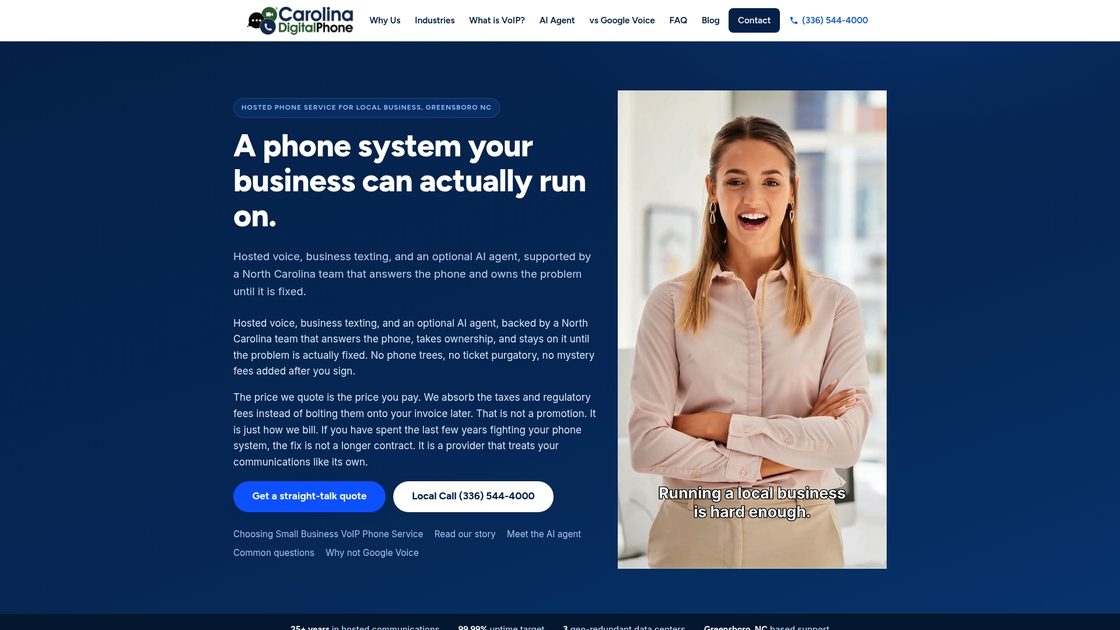
Carolina Digital Phone has built and supported hosted voice in North Carolina for more than 25 years, serving businesses, schools, and government agencies across North Carolina, South Carolina, and Virginia. The platform pairs clear-quality hosted voice with business texting from your real number, voicemail to email, mobile and desktop apps for remote and field teams, auto attendant, and call routing. An optional AI agent covers after-hours and overflow, and the system integrates with CRM and collaboration tools with HIPAA-aware options for healthcare.
The real differentiator is not a feature, it is a promise. A local team owns your issue from the first call and stays on it until it is fixed, and the price quoted is the price billed, with no surprise fees bolted on later. Behind that sit three geo-redundant data centers that keep call routing available across the region even when one site has trouble. For schools and agencies, campus-level emergency features and compliance-focused options are built in, not sold as an afterthought.
Pros:
- Local North Carolina team takes ownership during migrations and outages
- Transparent pricing with no surprise fees, plus free or discounted IP phones when you switch
- Three geo-redundant data centers for regional availability
- Business texting, mobile and desktop apps, auto attendant, voicemail to email, and routing in one service
- Optional AI call handling reduces after-hours load while people handle priority calls
Worth knowing:
- Public materials keep the focus on core communication tools rather than a long feature catalog, so the best way to see the full picture is a quick conversation.
Best for: businesses, schools, and government agencies in North Carolina, South Carolina, and Virginia that want local, responsive support and predictable billing. Pricing: straightforward and quoted on request, typically after a short assessment for multi-site or government deployments, with occasional phone discounts for customers who port and switch.
Real-world use: a regional school district moved its phones to Carolina Digital Phone to connect multiple campuses and support emergency notification, using room-level 911 integrated with existing fire alarm E911 systems, while district IT kept centralized control and the local team handled the cutover. Learn more about why organizations choose Carolina Digital Phone and our 45-year story in technology.
2. Allo
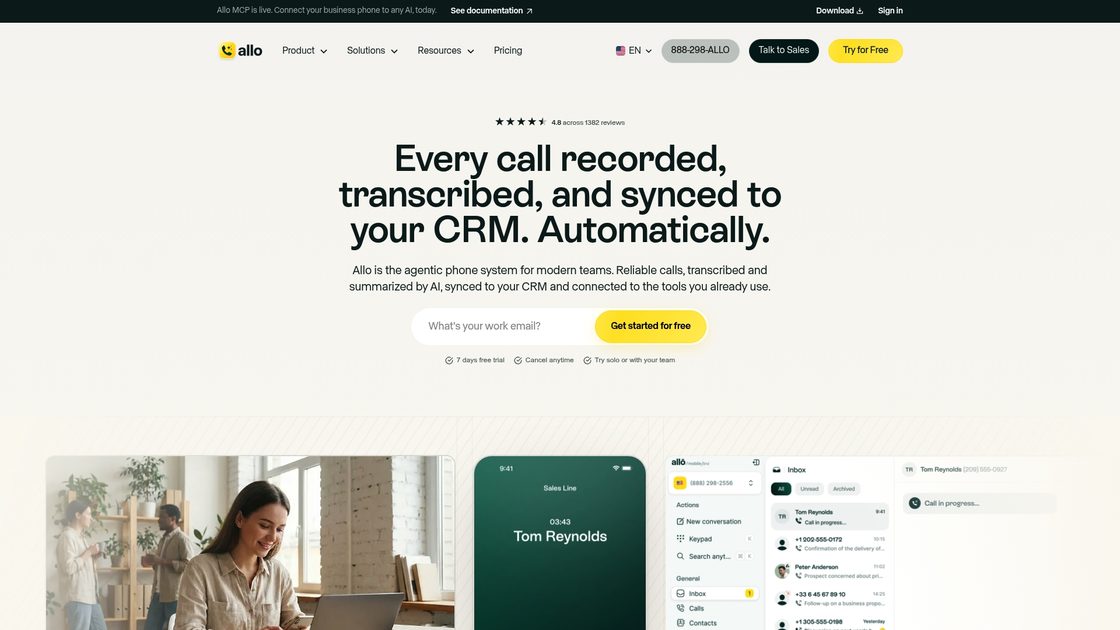
Allo leads with built-in automation at no extra cost and a Starter plan around $18 per user each month. It records calls, produces searchable transcriptions, and attaches AI-generated summaries and tags to each conversation, then pushes updates into your CRM so contact histories stay current without manual note-taking. An AI receptionist handles interactive routing, and international calling reaches more than 190 countries with around-the-clock support.
Pros: quick setup for small teams that scales up, AI transcription and automated follow-ups that cut admin, and a global calling backbone. Worth knowing:
- Audio can suffer on unreliable WiFi, which also affects transcript accuracy
- Usage and per-minute add-ons can make monthly spend hard to forecast
- Lower tiers limit advanced routing and enterprise customization
Best for: phone-heavy sales and support teams that want AI to cut manual work and sync to CRMs like HubSpot, Salesforce, and Pipedrive. Pricing: from $18 per user monthly, with core AI included and higher tiers adding routing and international minutes. Website: withallo.com.
3. VoiceSpin
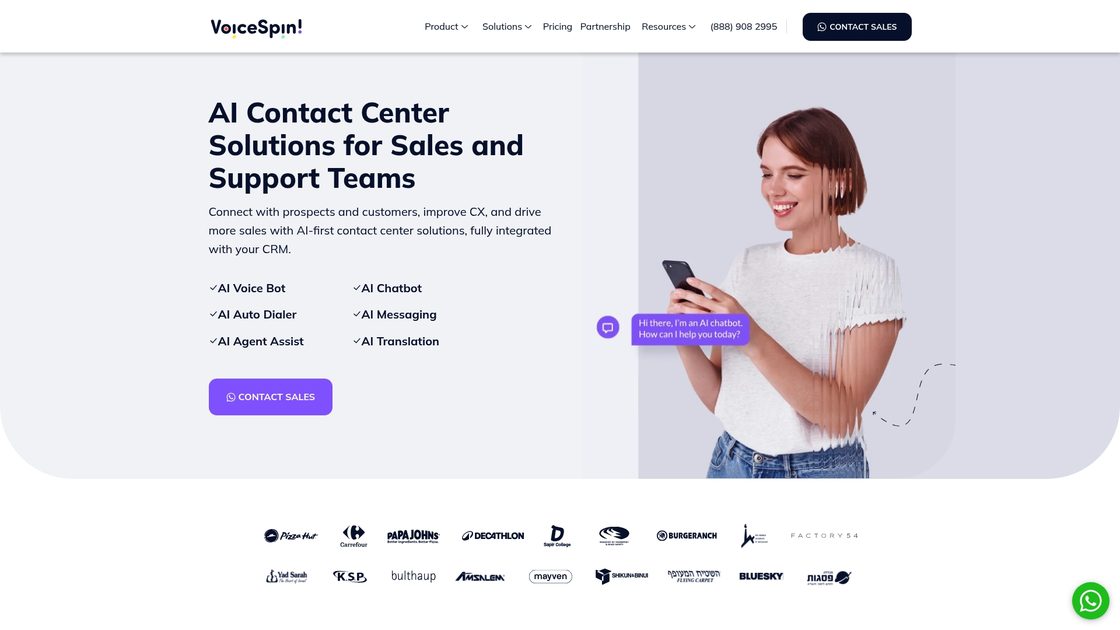
VoiceSpin is built for scale. It combines voice, email, SMS, social, WhatsApp, and live chat with AI voice bots, IVR, call queuing, a predictive dialer, and real-time monitoring, all connected to major CRMs. Local numbers in more than 160 countries make it a strong fit where international presence matters, and speech analytics plus automated voice handling reduce manual agent work on high call volumes.
Pros: broad CRM connectivity (Salesforce, Zendesk, HubSpot, Zoho, Dynamics 365, and more), heavy automation, and cloud scaling for remote teams. Worth knowing:
- Configuration and customization can be complex and time-consuming to set up
- Pricing is not published, so you must contact sales to compare total cost
- Onboarding for multichannel or highly customized flows can take real effort
Best for: mid-to-large enterprises running high-volume, international sales or support. Pricing: custom by deployment size and features, quoted on request. Website: voicespin.com.
4. MightyCall
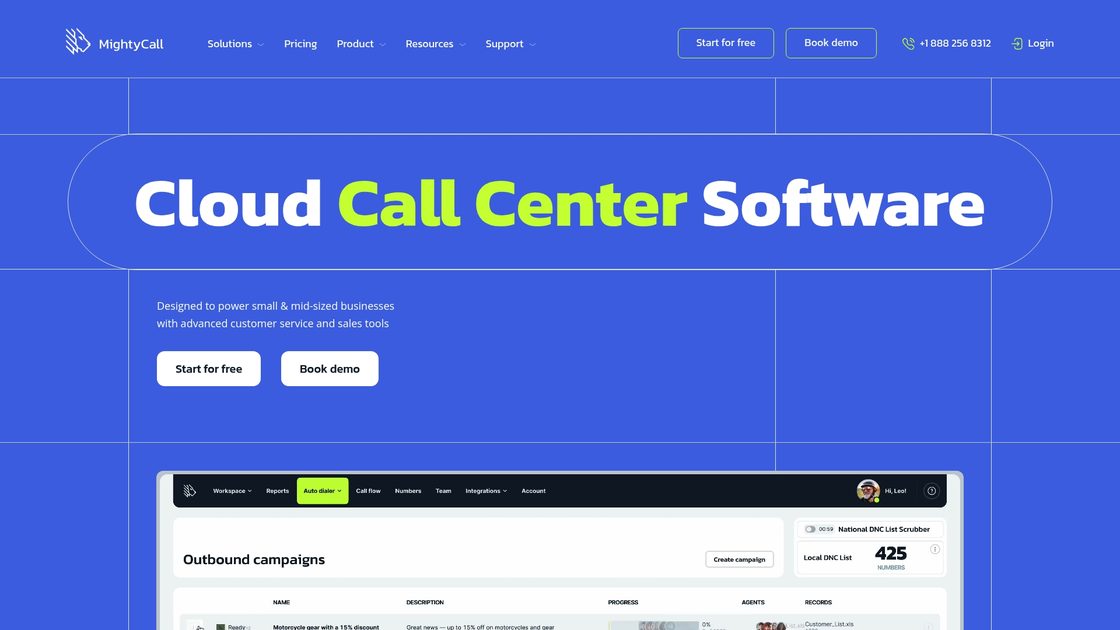
MightyCall advertises 99.99% uptime with HIPAA and FCC compliance and encryption, aimed at small to mid-sized businesses that need dependable voice. It brings a unified agent and supervisor view with automatic call distribution, live analytics, call queuing, multi-level IVR, and predictive, preview, and progressive auto-dialer modes for outbound campaigns.
Pros: strong call quality and availability, a deep inbound and outbound feature set, and well-regarded onboarding. Worth knowing:
- The many features and settings can feel complex to configure without technical staff
- Cost can climb for larger teams or advanced capabilities
- Fewer native integrations than some rivals, so some teams need custom work
Best for: SMBs that want a cloud call center with serious uptime and outbound automation and can spare some setup time. Pricing: from about $15 per user monthly, with higher tiers for advanced capacity. Website: mightycall.com.
5. Growifai
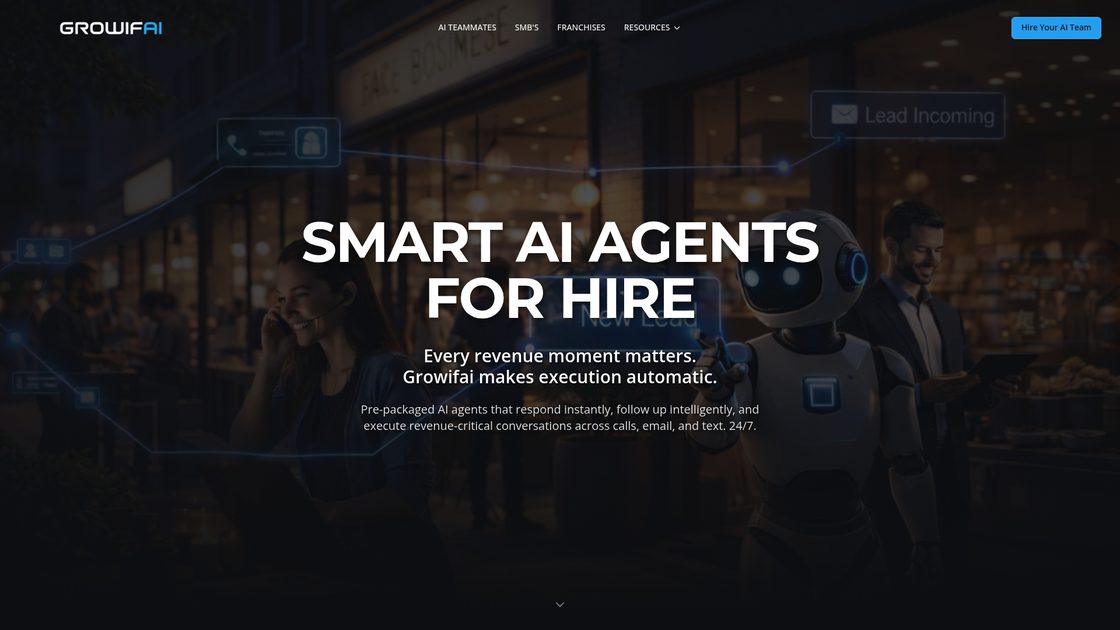
Growifai provides ready-to-use AI teammates that respond instantly across voice, SMS, and email, book appointments, send reminders and payment prompts, log conversations to CRM, and flag high-intent prospects for your salespeople. It is designed as an execution layer that supports human staff rather than replacing them, and it starts capturing missed revenue moments quickly because there is no heavy build phase.
Pros: accessible AI without a steep technical lift, automatic handling of scheduling and reminders, and lead prioritization. Worth knowing:
- AI replies can feel less nuanced than a live agent for delicate conversations
- Customization beyond the prepackaged agents takes configuration and project work
- It may not fully replace complex customer care that needs empathy and judgment
Best for: small and mid-sized businesses and franchise owners that live on phone and text and want to reduce front-line load. Pricing: not published, provided on request. Website: growifai.ai.
6. FloGPT
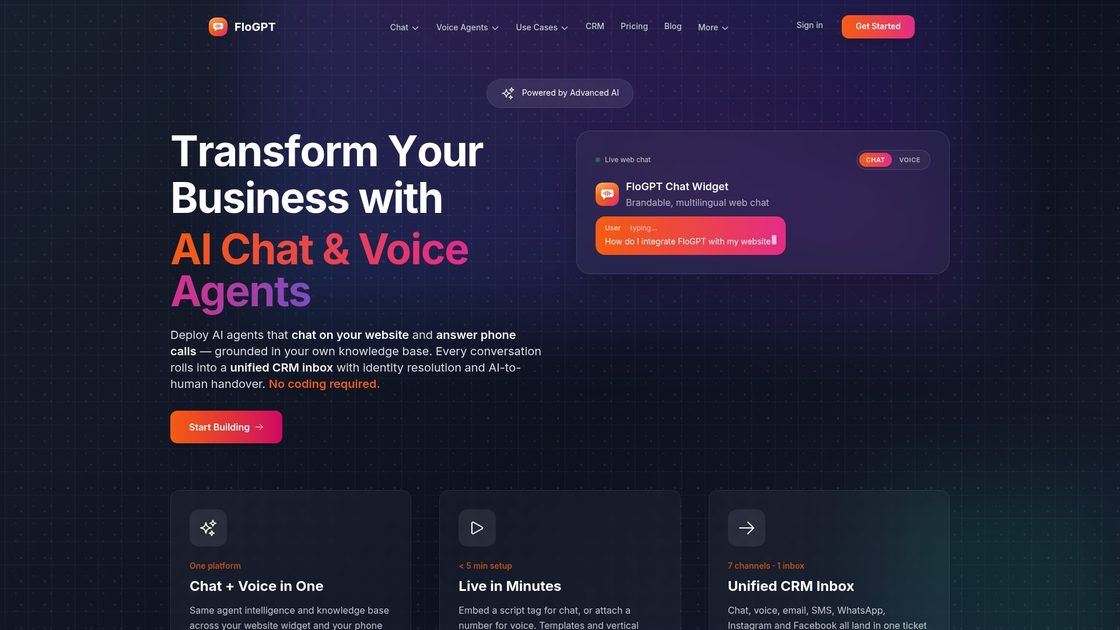
FloGPT advertises basic deployments live in under an hour. It offers an embeddable AI chat widget and an AI voice agent for inbound and outbound calls, both tied to a single CRM inbox, plus a knowledge base that cites sources to reduce hallucinations, visual workflow and call-pipeline builders, multi-language support, and preconfigured industry packs for lead generation and support.
Pros: centralizes conversations across voice, chat, SMS, email, and social, a no-code builder for nontechnical staff, and source-grounded answers. Worth knowing:
- Pricing for voice and outbound use is not fully transparent up front
- Complex customizations may need vendor engineering and a custom plan
- Independent third-party performance reviews are limited
Best for: SMB and enterprise support and sales teams that want one no-code platform for multi-channel engagement. Pricing: a free plan plus paid tiers for voice, outbound, and enterprise, with high-volume telephony potentially adding cost. Website: flogpt.com.
Comparison of the alternatives at a glance
Each of these platforms is strong for a specific job. The table below lines up the core trade-offs so you can see, quickly, which ones fit a locally supported, transparently priced deployment and which lean toward global scale or heavy customization.
| Provider | Core features | Key differentiator | Pricing | Main limitation |
|---|---|---|---|---|
| Carolina Digital Phone Our pick | Hosted voice, business texting, AI agent, CRM sync | Local NC support, ownership, transparency | Quoted on request | Limited advanced-feature detail in public materials |
| Allo | AI transcription, summaries, CRM sync | Built-in AI at no extra cost | $18/user/mo | Audio dips on poor WiFi |
| VoiceSpin | Omnichannel, AI bots, predictive dialing | Global scale with CRM-aligned AI | Not published | Complex setup and configuration |
| MightyCall | ACD, real-time analytics, auto-dialers | High call quality and uptime | $15/user/mo | Fewer native integrations |
| Growifai | AI agents for voice, email, and SMS | Ready-to-use SMB agents | Not published | Limited customization beyond presets |
| FloGPT | Chat and voice agents, unified inbox | One no-code multi-channel platform | Free plan + paid tiers | Voice pricing not fully transparent |
Our pick, and how to choose for your situation
If your priority is transparent pricing and locally accountable service, Carolina Digital Phone is the focused choice for organizations in its service region, pairing geo-redundant infrastructure and community-based support with billing you can actually plan around. If you are chasing global expansion, VoiceSpin's international number coverage is compelling. If AI-to-CRM automation is the point, Allo's auto-summaries earn their keep. If you want every channel in one no-code inbox, FloGPT fits, and if you want prepackaged SMB agents fast, Growifai delivers. There is no single winner for everyone. There is a best fit for you, and the fastest way to find it is to describe your real call flow to someone who installs these systems for a living.
Which AI contact center solution fits your local business, school, or agency?
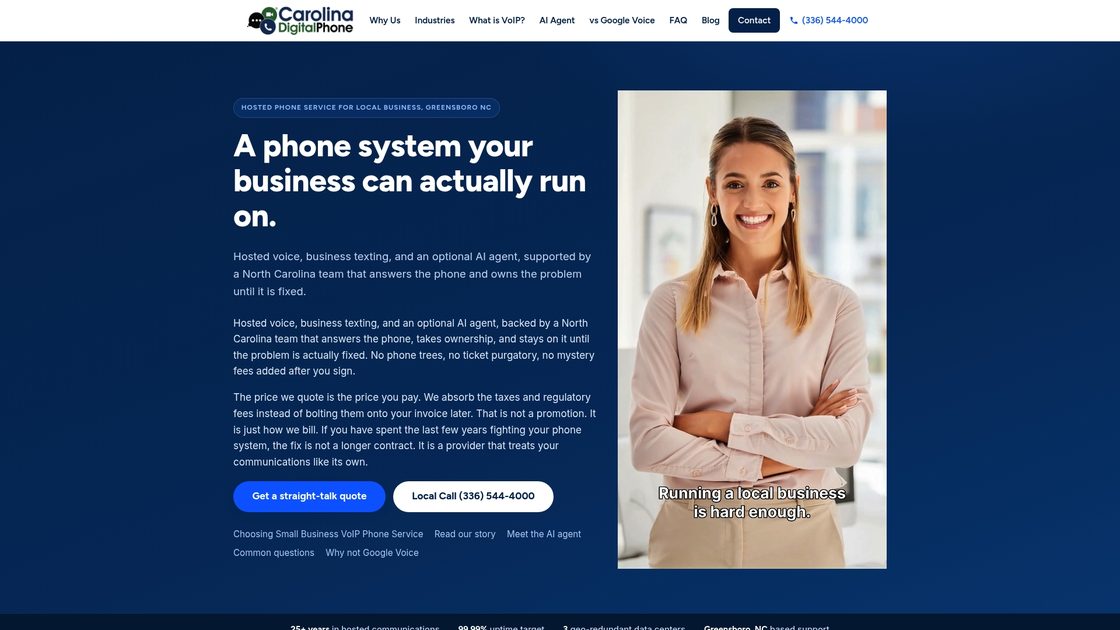
Choosing the right platform means solving the everyday headaches first: dropped calls, confusing bills, and slow support. Carolina Digital Phone answers those with clear pricing, a 99.99% uptime target, and real people in North Carolina who take ownership of your issue. Small and mid-sized businesses get business texting, AI agents, and mobile apps without unexpected fees, schools get campus-level emergency features, and agencies get compliance-focused options and local accountability during every cutover.
Not sure which of these six fits your workflow and budget? Call ☎ (336) 544-4000 and speak with a pre-sales voice engineer for a no-obligation evaluation of your business, school, or government agency needs before you move forward. No scripts, no pressure, just a straight answer from someone local.
AI contact center solutions: frequently asked questions
Carolina Digital Phone pairs clear call quality with mobile and desktop apps for remote and field teams, business texting, an optional AI agent, and CRM integration, all backed by transparent pricing that helps prevent unexpected fees. For businesses in North Carolina, South Carolina, and Virginia, the local, responsive support is often the deciding factor.
Allo lists about $18 per user monthly with built-in AI at no extra cost, which appeals to teams that want heavy AI automation at a published price. For organizations that value reliable local support and transparent billing with no hidden charges, Carolina Digital Phone tends to be the better fit.
Carolina Digital Phone provides campus-level emergency features, room-level 911, and integration with existing fire alarm E911 systems, along with predictable billing that fits a district budget cycle. That combination supports safety and communication continuity without a complex, high-maintenance setup.
Yes. Carolina Digital Phone targets 99.99% uptime and runs three geo-redundant data centers, which is important for organizations that rely on uninterrupted communication. Reliability like this should be near the top of your checklist when comparing any provider.
VoiceSpin is built for high volume, with AI voice bots, a predictive dialer, and omnichannel routing at global scale. If you also need local, hands-on support and simple billing, weigh that scale against Carolina Digital Phone's regional ownership model, and talk to a pre-sales voice engineer before deciding.
Start with a short, honest conversation about how calls come into your organization today and where they break down. Call (336) 544-4000 for a no-obligation evaluation, and a pre-sales voice engineer will help you match the right approach to your business, school, or government agency needs before you commit to anything.
Get a no-obligation evaluation before you choose.
Tell us how your calls, texts, and CRM work today, and a Carolina Digital Phone pre-sales voice engineer will help you find the right fit for your business, school, or government agency needs. No pressure, no runaround, just local expertise.
Request my free evaluation