Government Phone Systems Built for Public Service
Secure hosted VoIP, messaging, and fax for city, county, state, and federal agencies. Mission-critical reliability, compliance-ready security, and a local North Carolina team that specializes in government projects large and small.
Quick answer: what phone system do government agencies need?
A government phone system has to be reliable enough for emergencies, secure enough for sensitive records, and simple enough for a three-person town office to run. Carolina Digital Phone, a Greensboro, North Carolina company founded in 2000, provides hosted VoIP, text messaging, and digital fax for city, county, state, and federal agencies across North Carolina, South Carolina, and Virginia. Every deployment includes direct 911 dialing with room-level location, call recording on official numbers, and geo-redundant data centers. Our dedicated government sales team answers at (336) 543-0000.
- Hosted VoIP for government
- A phone system that runs over your network from secure data centers, with no PBX hardware to buy or maintain in the building.
- Kari's Law
- The federal rule that every phone must dial 911 directly, with no prefix, and notify designated staff when it does.
- RAY BAUM'S Act
- The federal rule that a 911 call must carry a dispatchable location: the building, floor, and room.
- Public records
- Under North Carolina law, records of public business include sound recordings. Call recording and retention settings help your clerk answer a request.
- Official number
- A phone number assigned to the office or position, not the person, so it stays with the agency when staff change.
- Geo-redundant
- Service that runs in more than one data center in different regions, so one outage does not take your phones down.
Published by Carolina Digital Phone. Last reviewed October 7, 2026 by Nicky Smith, founder.
Why do government agencies choose Carolina Digital Phone?
Because your community has to be able to count on its communications, and so do you. Are you a government decision-maker looking to modernize your agency's communication infrastructure? Carolina Digital Phone has been a trusted technology partner in the Piedmont Triad since 2000, led by technologists with more than four decades in the industry, and we understand something the national providers never will: every agency serves a different community, with different departments, different budgets, and different obligations to the public.
That is why we do not sell government agencies a one-size-fits-all bundle. We design scalable hosted VoIP, messaging, and fax solutions around your actual operation, whether you are a small municipal office, a county health department, a state agency, or a multi-site organization with facilities across the region. Your citizens rely on you. You can rely on us.
Mission-Critical Reliability
A 99.99% uptime target and geo-redundant data centers keep government communications operational, supporting essential services and emergency response when your community needs you most.
Compliance Ready
Carolina Digital Phone's VoIP, messaging, and fax solutions align with regulatory frameworks and public-sector security requirements, from HIPAA and FISMA to E911 mandates.
End-to-End Security
Encrypted voice, fax, and messaging protect sensitive information across every channel, on-premises or in the cloud, backed by hardened data centers and secure provisioning.
Nationwide Coverage
Our carrier-owned network provides reliable connectivity across all U.S. regions, ensuring clear, consistent communication for every agency, office, and field location.
How does one platform connect every department?
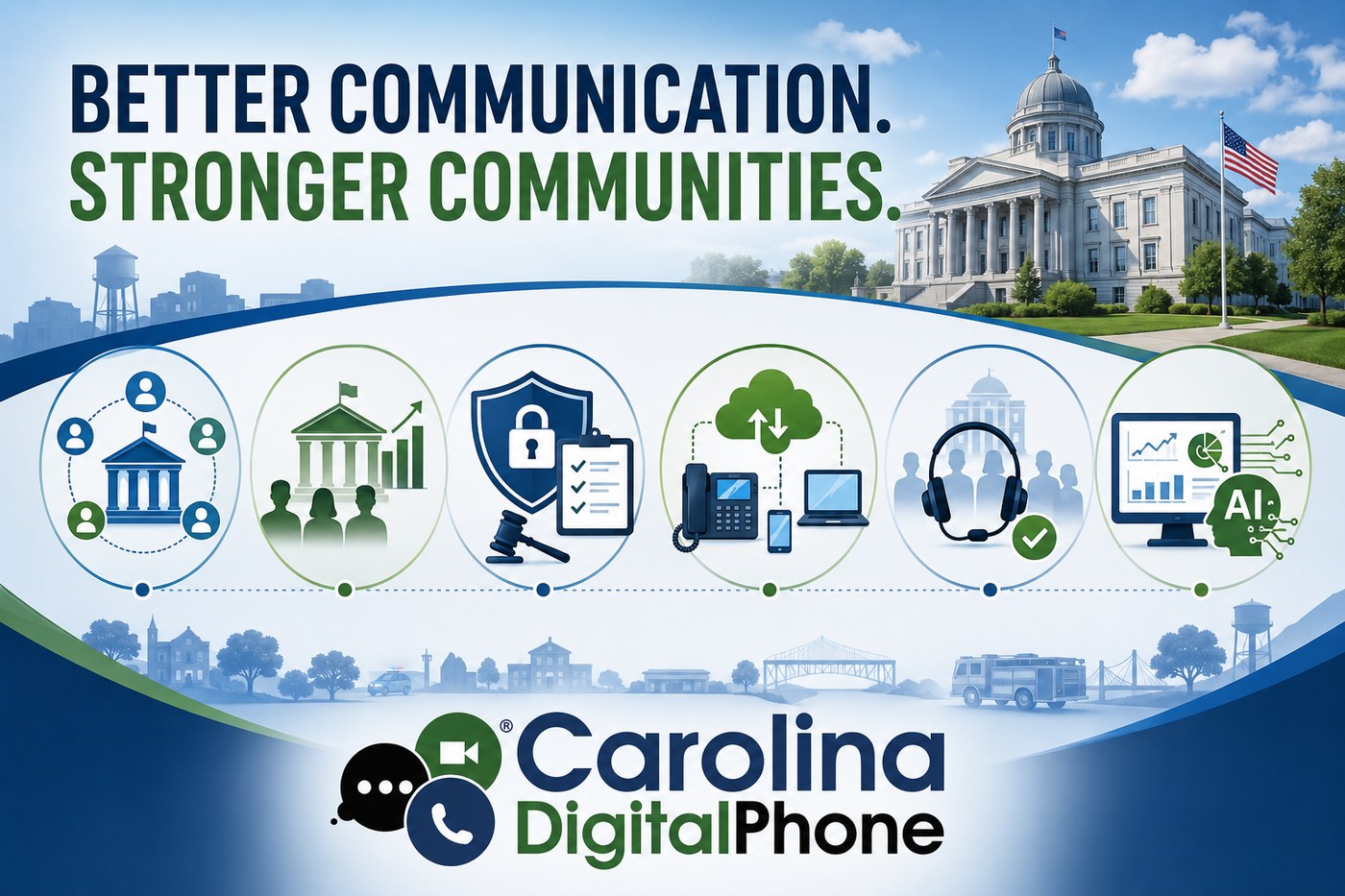
Better communication makes stronger communities. Keeping every department and team connected is essential for every municipality and government agency. One platform carries your phones, text messaging, fax, and mobile apps, so information moves as fast as your community expects.
Streamline your communications
With our hosted VoIP solutions you get state-of-the-art call quality plus a deep feature set that makes daily communication easier and more efficient: auto attendants that route citizens to the right department the first time, ring groups that make sure a call to the tax office is answered even during lunch coverage, voicemail transcribed to email, and text messaging on your published office numbers so residents can reach you the way they already reach everyone else.
Should elected officials use personal cell phones for public business?
No. Give leaders an official line, not a personal cell number. Elected officials and department heads need to stay in close contact with the citizens they serve. What they should never have to do is hand out a personal cell phone number to do it. With Carolina Digital Phone, every office and every leader gets a private telephone number assigned to the position, reachable from a desk phone, computer, or our mobile app.
Calls on that official number can be easily recorded and monitored for accuracy, which protects the office, supports public records obligations, and keeps a reliable account of commitments made to constituents. When staff change, the number stays with the office, so continuity of service never depends on somebody's personal device. Officials simply make and receive calls through our hosted application, and their personal numbers stay personal.


Can government employees work from home on the same phone system?
Yes, and from anywhere else they need to serve. Public service is delivered by people, and those people deserve tools that work as hard as they do. Every employee gets a full communications toolkit: desk phone, softphone on their computer, the Digital Voice Plus mobile app, team chat presence, and voicemail that follows them, all tied to their official extension. A permit question, an inspection scheduling call, a utility billing dispute: each one lands with the right person quickly, and the citizen never hears "you will have to call a different number."
Hybrid work is now a permanent part of government staffing, and it is one of the strongest recruiting tools an agency has. With a hosted system, your office can let staff work from home when needed, on snow days, during building maintenance, or as part of a standing schedule, while communication with both colleagues and citizens stays seamless. The employee answers the same extension at the kitchen table that they answer at the counter, callers notice no difference, and supervisors keep full visibility through reporting and call analytics.
Improve organizational practices with confidence
Whether you are outfitting a small agency office or a growing municipality, our team helps you find the approach that fits: the best way for a hybrid team to stay connected, the call center configuration that serves your residents fastest, the reporting that shows a council or commission exactly how citizen calls are being handled. When your communication platform is reliable and measurable, you can refine your practices year after year, and the result is an organization your community trusts.
How does replacing an old PBX save taxpayer money?
Outdated equipment is a liability, and retiring it is a savings. Aging PBX hardware in a closet is more than an inconvenience. It is a budget risk. Replacement parts get scarce, the technicians who understand it retire, and every move, add, or change requires a costly service visit. When it fails, and old equipment always eventually fails, your agency goes silent with no warning and no plan. Here are the signs your PBX needs replacement.
A hosted voice system flips that math in the taxpayer's favor. There is little to no upfront capital outlay for equipment and installation, so modernization fits inside an operating budget instead of competing for capital funds. Moves, adds, and changes take minutes in a web portal instead of a billable truck roll. Upgrades arrive automatically in the cloud, so the system your agency uses in year five is better than the one you started with, at the same predictable monthly cost per user.
The taxpayer's bottom line: no capital purchase, no depreciation schedule, no maintenance contracts on aging hardware, and no surprise replacement project when a twenty-year-old PBX finally quits.

What security and compliance rules apply to a government phone system?
Federal 911 rules, privacy and security frameworks, and state public records law. For government agencies and municipalities, compliance with local, state, and federal regulations is not optional. Your phone system should make it easier, not harder.
Our hosted platform is built to meet strict public-sector security requirements and protect sensitive data in motion and at rest. Encrypted voice, secure digital fax, and protected messaging help your agency remain aligned with critical frameworks such as HIPAA for health departments and FISMA-driven security expectations for agencies handling federal information. From navigating privacy standards to documenting how your communication systems meet requirements, our expert VoIP technicians and support team guide you through it, so your solution stays compliant and secure as regulations evolve.
| Requirement | Rule or framework | How our platform handles it |
|---|---|---|
| Dial 911 directly, with no prefix | Kari's Law | Every phone dials 911 with no access code |
| Notify staff when 911 is dialed | Kari's Law | On-site notification to the people you designate |
| Send responders the exact location | RAY BAUM'S Act | A dispatchable location for every phone: building, floor, and room |
| Protect health information | HIPAA, for health departments | Encrypted voice, secure digital fax, and protected messaging |
| Protect federal information | FISMA-driven security expectations | Hardened data centers, secure provisioning, and role-based administration |
| Answer public records requests | State public records law | Call recording on official numbers, call detail reports, and retention settings |
| Stay reachable in an outage | Continuity of operations planning | Geo-redundant data centers and automatic rerouting to mobile apps or other sites |
E911 done right: Kari's Law and RAY BAUM'S Act
Emergency calling rules matter enormously in public buildings. Federal law now requires that anyone in your facility can dial 911 directly with no prefix, that designated staff are notified when a 911 call is placed, and that a dispatchable location, down to the building, floor, and room, travels with the call. Our platform delivers direct 911 dialing, on-site notification, and accurate location routing across single buildings and multi-site campuses, and we configure and test it as part of every government deployment. Our guide shows how to assign dispatchable E911 locations.
Records, retention, and accountability
Public records obligations extend to communications. In North Carolina, the public records law counts sound recordings made in the course of public business. Call recording on official numbers, call detail reporting, voicemail retention, and message archiving give your clerk and your attorney what they need when a records request arrives, and give leadership an accurate account of how citizen interactions were handled.
- Encrypted voice, messaging, and digital fax across every channel
- Direct 911 dialing, on-site notification, and dispatchable location for every phone
- Call recording and monitoring on official office numbers for accuracy and accountability
- Geo-redundant data centers and robust backup systems that keep critical communications running during outages
- Role-based administration so IT keeps control without becoming a bottleneck
How does a hosted system fit complex government buildings and multi-site operations?
With a deployment plan built for your buildings, not just a shipment of phones. Government infrastructure is rarely simple. Historic buildings, secure facilities, mixed networks, and multi-site operations all demand it. Our customized, flexible approach integrates hosted communication tools into complex environments without disrupting daily service, and your system scales as your organization grows: add a seasonal worker in minutes, stand up a new satellite office in days, expand a call center for tax season and shrink it afterward.
Continuity is engineered in. Redundant, geo-diverse infrastructure and automatic failover keep critical communications available during power or network outages, and calls can instantly reroute to mobile devices or alternate sites when a facility goes dark. See a municipal phone failover example. From phone and email to SMS and webchat, your residents get a consistent, personalized omnichannel experience, and your staff get one system to learn instead of five.
Who will your agency work with?
A dedicated government team, right up the road. Selling to government is not the same as selling to business, and we staff accordingly. Carolina Digital Phone has dedicated team members who specialize in government projects large and small: they understand fiscal-year budget cycles, procurement and quote documentation, multi-department stakeholder reviews, and the phased cutovers that keep a public office reachable on day one. From a three-line town office to a multi-site county deployment, the same team designs it, installs it, trains your staff, and answers the phone afterward.
We know the needs of your town, city, county, or health department, and we can quickly and easily implement a cost-effective, secure voice, messaging, and fax solution around them. And because we are headquartered in downtown Greensboro, help is local. When you call, you reach experienced staff in North Carolina, and when the question is technical, a senior engineer joins the conversation without an escalation queue. There is never a wait to get a senior engineer working on your problem. That accountability, plus 25 plus years of service to organizations across NC, SC, and Virginia, is why agencies choose a local partner over a faceless national brand. You can also explore our broader public sector solutions for schools, public safety, and community organizations, or read about government phone systems on our main site.
What should a government IT director read next?
These guides come from the team that installs in public buildings. Each one gives you a straight answer whether you buy from us or not.
Our government guides
More from Carolina Digital Phone
Primary sources
What do government leaders ask about hosted phone systems?
What types of government organizations does Carolina Digital Phone serve?
We serve city and town offices, county departments, health departments, state agencies, federal offices, public safety and military-adjacent operations, and special districts across North Carolina, South Carolina, and Virginia. Deployments range from small single-office municipalities to multi-site organizations with hundreds of users.
Does a hosted phone system meet government compliance requirements?
Our hosted VoIP, messaging, and fax solutions align with public-sector security requirements and support compliance with frameworks such as HIPAA for health-related agencies and FISMA-driven federal security expectations. Encrypted communications, call recording, retention-friendly reporting, and E911 compliance with Kari's Law and RAY BAUM'S Act are built into government deployments. See our government phone compliance requirements guide.
Does the system meet Kari's Law and RAY BAUM'S Act?
Yes. Every phone dials 911 directly with no prefix, designated staff are notified when a 911 call is placed, and a dispatchable location, down to the building, floor, and room, travels with the call. We configure and test this as part of every government deployment. These are the FCC's 911 requirements for multi-line telephone systems.
How does a cloud phone system save taxpayer money?
There is little to no upfront capital outlay for equipment and installation, so modernization fits in the operating budget. Moves, adds, and changes are done in minutes through a portal instead of billable service visits, maintenance contracts on aging PBX hardware disappear, and upgrades arrive automatically at the same predictable per-user monthly cost.
How do government agencies buy a hosted phone system?
Most start with a consultation and a written quote that documents the scope, the per-user monthly price, and the implementation phases for your purchasing office. Our government team understands fiscal-year budget cycles, procurement and quote documentation, and multi-department reviews, and can plan a phased cutover that fits your budget year.
Can government employees work from home on the system?
Yes. Every employee's official extension works on a desk phone, computer softphone, and mobile app. Staff can work from home during weather events, building closures, or on a standing hybrid schedule while answering the same official number, and supervisors retain full visibility through call reporting and analytics.
Do officials have to use personal cell phones for public business?
No, and they should not. Each office or leader is assigned a private official telephone number that works through our hosted mobile and desktop apps. Calls on the official number can be recorded and monitored for accuracy and records purposes, and the number stays with the office when staff change, so personal cell numbers stay private.
Can call recordings help with public records requests?
Yes. Call recording on official numbers, call detail reporting, voicemail retention, and message archiving give your clerk and your attorney what they need when a records request arrives. Our guide explains how to configure call recording retention.
Can we keep our published phone numbers?
Yes. Your published office numbers move to the new system through number porting, so residents keep dialing the numbers they already know. We schedule the move so every office stays reachable. Read about a cloud phone system with number porting.
What happens to our phones during a power or internet outage?
Because the system lives in geo-redundant data centers rather than a closet in your building, an outage at your facility does not take your communications down. Calls automatically reroute to mobile apps, alternate sites, or designated backup numbers, so citizens can still reach your agency when it matters most.
Is there a dedicated government sales contact?
Yes. Carolina Digital Phone has a dedicated government team with its own direct line, (336) 543-0000. The same team designs your system, installs it, trains your staff, and answers the phone afterward.
Let's build your agency's communication plan
Talk with our dedicated government team about a secure, cost-effective hosted voice, messaging, and fax solution for your town, city, county, or agency. Local experts, senior engineers on the first call, and more than 25 years serving the Carolinas.
Request a government consultation Government Sales: (336) 543-0000