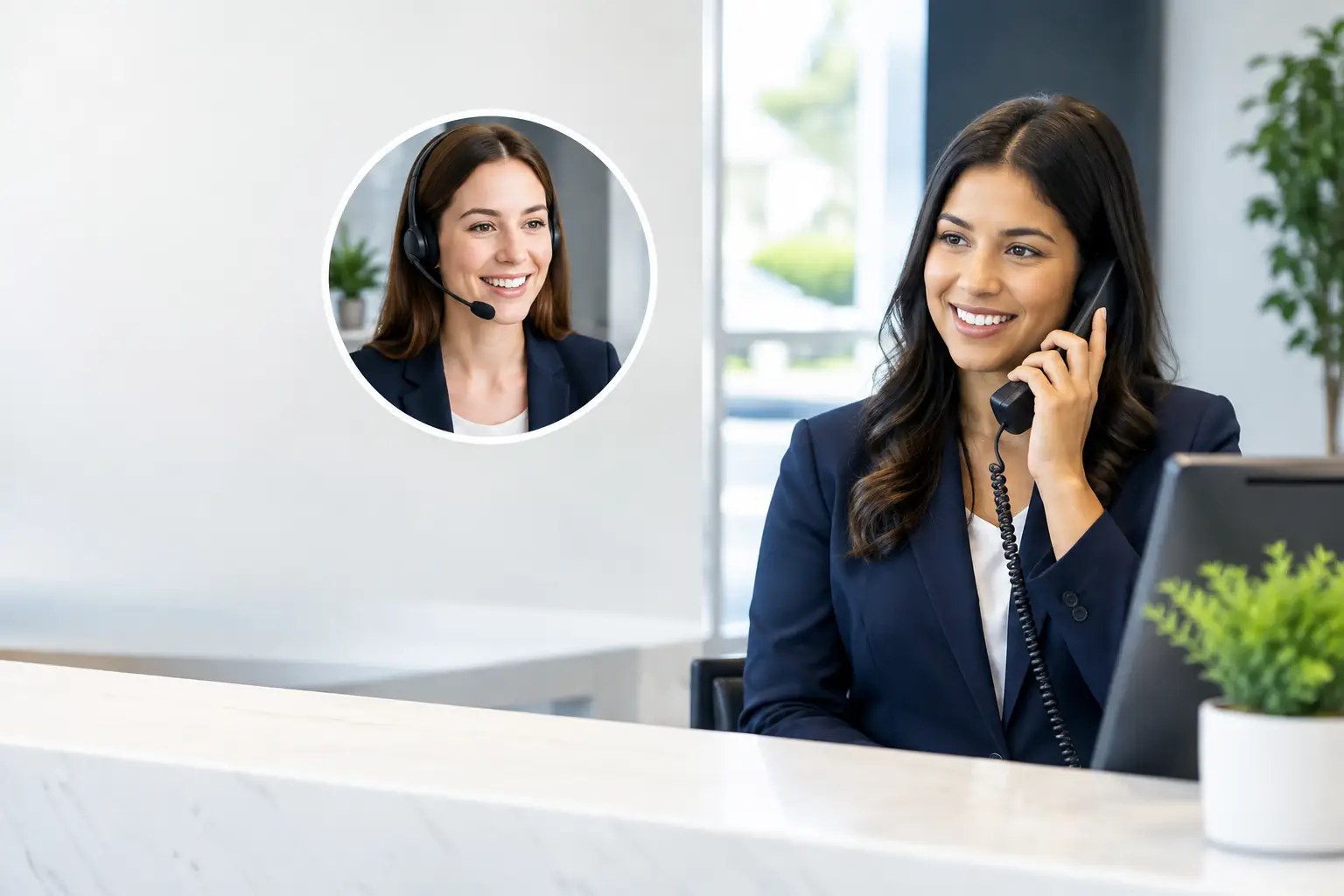
Published October 16, 2026. Last updated October 16, 2026.
Quick answer: AI receptionist or live receptionist?
Use an AI receptionist for calls that begin the same way: hours, directions, appointment requests, routine status questions, department routing, and after-hours intake. Use a live receptionist for calls where the first conversation shapes trust or needs judgment: complex intake, complaints, worried or vulnerable callers, sensitive financial or medical matters, and anything likely to be an exception. Most small and mid-sized organizations land on a hybrid, where the AI answers first, handles the predictable calls, and hands qualified or sensitive calls to a person. Neither option fixes a call flow your staff has not agreed on.
- AI receptionist
- Software that answers with conversational voice, follows the information and call rules you give it, answers approved questions, collects details, transfers, and takes messages.
- Live receptionist
- A person, on staff or through a receptionist service, who can hear hesitation, calm an upset caller, and make a judgment call when the script does not apply.
- Hybrid model
- AI answers first, identifies the purpose, handles the routine, and transfers the rest to a live receptionist or team; also covers overflow and after hours.
- Call flow
- The planned route a call takes from greeting to resolution, including what happens when the first person does not answer.
A caller reaches your office at 6:15 p.m. They need to schedule service, confirm an appointment, report a facilities issue, or find the right department. The practical question behind AI receptionist vs live receptionist is not which option sounds more modern. It is whether your organization can give that caller a useful next step without adding work your staff cannot support.
For many small and mid-sized organizations, the right answer is not strictly one or the other. An AI receptionist can handle predictable first-contact calls around the clock. A live receptionist provides judgment, empathy, and accountability when the conversation is complicated or sensitive. Your call volume, callers, hours, and internal process should decide the mix.
Local Business VoIP is the small-business site of Carolina Digital Phone, Inc. We operate an AI receptionist at DigitalPhone.ai, and we have also spent 25 years configuring phone systems for offices with a real person at the front desk. We sell one of these and have no stake in the other, so I want to be plain about the cases where the person wins.
An insurance agency in High Point asked us to put an AI receptionist on their main line last year. Their receptionist was excellent and overwhelmed. Every policy question, every claim call, every "is my agent in," all landed on her, and callers who got voicemail did not call back.
We did not replace her. We put the AI in front of her. It now answers first, handles hours, directions, payment questions, and "which agent handles my policy," and sends everything else to her desk with the caller's name and reason already captured. Claims and anything with a worried voice go straight to a person.
Her call count dropped by about a third. The calls she takes now are the ones that needed her in the first place. That is what the hybrid looks like when it is working.
What is the main difference between an AI receptionist and a live receptionist?
One follows rules and the other exercises judgment. An AI receptionist is software that answers calls using conversational voice technology. It can greet callers, ask what they need, answer approved questions, collect basic information, transfer calls, take messages, and send appointment or service-request details to your team. It follows the information and call rules you give it.
A live receptionist is a person who answers calls, either as an employee or through a receptionist service. A person can hear hesitation, recognize an unusual problem, calm an upset caller, and make a judgment call when the usual script does not apply.
That distinction matters. AI is generally strongest when your callers ask recurring questions and need clear routing. A live person is generally stronger when the caller's need is uncertain, emotional, detailed, or high stakes.
Neither option fixes a poorly designed call flow. If your staff has not agreed on where billing calls, maintenance requests, enrollment questions, and urgent after-hours issues should go, callers will still get transferred in circles. The technology should support a clear process, not stand in for one. If that process is not written down yet, start with our guide on how to set call routing.
| Factor | AI receptionist | Live receptionist |
|---|---|---|
| Coverage | 24 hours, no breaks, several callers at once | Business hours, one caller at a time, gaps for absences |
| Consistency | Same questions asked and same details captured every time | Varies with training, workload, and the person |
| Judgment | None beyond the rules given; cannot interpret policy or read tone | Hears hesitation, handles exceptions, de-escalates |
| Trust and discretion | Fine for routine; weak for worried or reluctant callers | Strong where the first conversation shapes the relationship |
| Cost shape | Monthly fee by minutes or interactions, plus setup and ongoing updates | Salary or service fee, plus training, documentation, and coverage for absences |
| Maintenance | Someone must own the approved answers and routing rules | Someone must own training, scripts, and escalation rules |
| Emergency calls | Must direct the caller to 911, never manage the emergency | Can recognize urgency and escalate by judgment |
Where does an AI receptionist earn its place?
On calls that begin the same way. A property management office may receive routine questions about leasing, maintenance, rent payments, and office hours. A home services company may need to collect a caller's address, service type, and preferred callback time. A professional office may need to direct callers to scheduling, billing, records, or a specific extension.
In those situations, AI can offer consistent coverage outside business hours and during busy periods. It does not need a lunch break, and it can answer more than one caller at a time when configured with the right call handling. That can reduce the number of calls that reach voicemail simply because the front desk is busy with someone standing in the office. If that is already happening, our guide on why calls go straight to voicemail will tell you how often.
It can also give callers a more natural first step than a long keypad menu. Instead of asking callers to press one for sales and two for support, the system can ask, "How can I help you today?" A caller who says, "I need to reschedule my appointment," can be routed to the right team or offered the next approved action. We compared that against a traditional menu in auto attendant versus receptionist.
There are operational benefits as well. A well-configured AI receptionist can gather the same details every time, such as name, callback number, location, and reason for the call. That helps field-service teams and office staff start with usable information rather than a vague voicemail. For organizations with mobile employees, it can route calls to a ring group, a queue, or a mobile softphone based on business hours and staff availability.
Where the AI stops
The limits are just as important. AI should not be left to invent answers, interpret policy, or handle matters that require professional judgment. Healthcare offices, schools, and local government departments may receive calls involving personal information, safety concerns, service eligibility, or urgent situations. Those calls need carefully defined escalation paths. If a caller reports an immediate emergency, the system should tell them to call 911 rather than attempt to manage the emergency itself.
AI also needs ongoing attention. Office hours change. Staff leave. Department names shift. Holiday schedules arrive. If nobody owns the approved answers and routing rules, the experience becomes dated quickly. Our AI receptionist review for SMBs covers the tests to run before you buy one and the questions to ask the vendor.
When is a live receptionist worth the cost?
When the first conversation shapes trust or requires discretion. Law offices, insurance agencies, medical practices, financial offices, and senior living communities may receive callers who are worried, confused, or reluctant to explain their situation to an automated system. A trained person can slow down, ask a clarifying question, and recognize when a caller needs immediate attention from someone on staff.
A person also handles exceptions better. Consider a school district office during weather-related schedule changes, a municipality receiving a confusing service complaint, or a construction company coordinating an issue at an active job site. The caller may use different words than your usual categories. A good receptionist can connect the dots and find the correct contact.
The tradeoff is coverage and staffing. One person cannot answer every call while greeting visitors, processing paperwork, helping colleagues, and taking breaks. Absences and turnover can expose a gap at the front desk. An outsourced live receptionist service can extend coverage, but it still depends on the training, scripts, access, and escalation rules you provide.
Cost is more than an hourly rate or monthly service fee. Consider the time required to train reception staff, document call procedures, cover absences, and correct missed messages. Also consider the value of a caller reaching a capable person on the first attempt. For some organizations, especially those with complex intake calls, that value justifies the expense. The Bureau of Labor Statistics occupational outlook for receptionists is a reasonable starting point for the salary side of that math.
Which option fits which call type?
Start by listening to what callers actually ask. Review a representative sample of calls, voicemail messages, and front-desk notes. You are looking for patterns, not just total call volume.
AI is usually a reasonable first responder for office hours, directions, basic service information, appointment requests, routine status questions, employee directories, and straightforward department routing. It can also work well as an after-hours layer that gathers information and sends an alert or message for next-business-day follow-up.
A live receptionist should remain central for complex intake, complaints that need de-escalation, calls involving vulnerable people, sensitive financial or medical discussions, and situations where an exception is likely. Government and education organizations should be especially cautious about putting public safety, crisis, or urgent operational reports into an open-ended automated path.
The hybrid most offices end up with
Some calls belong in a hybrid model. An AI receptionist can answer first, identify the purpose of the call, and transfer qualified calls to a live receptionist or the appropriate team. It can handle the overflow when the live receptionist is already assisting someone. After hours, it can provide approved information and capture a message, while urgent categories follow a defined on-call route.
That model can be practical for a Greensboro professional office, a multi-location contractor, or a school administrative department with regular call spikes. It preserves human attention for the conversations where it matters most without leaving ordinary callers waiting for a person to become available.
- Does the call begin the same way every time? AI first.
- Could a wrong answer cost money, safety, or trust? Person, always.
- Is the caller likely to be worried, confused, or reluctant? Person.
- Is it after hours and not urgent? AI captures it for morning.
- Is it after hours and urgent? AI identifies it and routes to on-call, never handles it.
- Is the front desk already on a call? AI takes the overflow.
What questions should you answer before deploying either option?
The operational ones. What should happen when the first person does not answer? Which departments may receive outside transfers? What information may be collected, repeated, or sent by text or email? Who updates holiday hours and staff changes? Which calls must reach an on-call employee, and which can wait until morning?
For a phone system, these decisions are part of call flow design: the planned route a call takes from greeting to resolution. Build it around real staffing conditions, not an ideal day when everyone is available. Include a fallback for a missed transfer, an unavailable department, and a caller who does not understand the first question. Our holiday call schedule guide covers the part everyone forgets until December.
Test the experience from a caller's point of view. Call from a mobile phone. Ask an unusual question. Stay silent for a few seconds. Request a person. Try after hours. If the system cannot give a clear answer or route, revise it before opening it to customers or constituents.
The honest version of the vendor pitch. We sell an AI receptionist. The cases where I would tell you not to use one: your calls are mostly complex intake, your callers are often distressed, your call volume is a handful a day, or nobody on your staff will own the approved answers. In those cases a good person at the front desk, backed by sensible routing, beats the software.
With a hosted VoIP system, the routing can be adjusted as your needs change. Carolina Digital Phone helps organizations plan these call paths, configure the phone system, and make sure a local support team can help when a change is needed. The AI service, if used, should fit the way your organization actually answers and owns calls. The complete list of features shows where the AI receptionist sits alongside queues, ring groups, and the mobile app, and our why Carolina Digital Phone and history pages explain who answers when you call us.
The better choice is the one that gives callers a clear, respectful path while your team can reliably support it. Use AI for repeatable work, broad coverage, and well-defined routing. Use live reception for judgment, reassurance, and exceptions. Keep a human path available when the call deserves one. A phone system should not make callers work harder to reach you. When your greeting, routing, and staffing plan reflect how your organization operates, the caller hears the difference before they ever reach the right person.
Frequently asked questions about AI receptionists and live receptionists
Can an AI receptionist replace a live receptionist?
For routine calls, yes. For calls that need judgment, discretion, or de-escalation, no. Most organizations use the AI to answer first and handle the predictable calls, then transfer the rest to a person. The receptionist keeps the calls that needed her in the first place.
What calls should never go to an AI receptionist?
Anything where a wrong answer costs money, safety, or trust: complex intake, complaints, calls from worried or vulnerable people, sensitive financial or medical matters, and emergencies. An AI should tell an emergency caller to dial 911, never try to manage the emergency.
Is an AI receptionist cheaper than a live receptionist?
Usually on the monthly fee, but the real comparison includes setup, someone to own the approved answers and routing, and the cost of a caller who hangs up on an automated system. A live receptionist's cost includes training, documentation, and coverage for absences. Compare the full cost of each against the calls you actually get.
What is a hybrid receptionist model?
The AI answers first, identifies the purpose of the call, handles hours, directions, routine questions, and intake, and transfers qualified or sensitive calls to a live receptionist or the right team. It also takes overflow when the person is busy and captures after-hours messages while routing urgent categories to on-call.
How do I decide which calls go where?
Review a sample of real calls, voicemails, and front-desk notes and sort by pattern, not volume. Calls that begin the same way go to AI first. Calls likely to be exceptions, emotional, or high stakes stay with a person. Write the result down as a call flow with fallbacks for a missed transfer and an unavailable department.
Who maintains an AI receptionist after it is set up?
Someone on your staff, by name. Hours, holidays, department names, and staff change constantly, and an AI that nobody updates gives confident wrong answers within months. Decide the owner before you turn it on, the same way you would decide who trains a new receptionist.
Not sure which calls need a person?
Carolina Digital Phone will sort a sample of your real calls with you and show you what a hybrid setup would look like on your own phone system. Call (336) 544-4000 and talk to a local engineer, or request a call flow review online.
Call (336) 544-4000 Request a Call Flow ReviewSee the AI receptionist at DigitalPhone.ai, get a fast quote at HostedBusinessTelephone.com, or talk to a founder who still answers.