Call recording has become a business essential
"This call may be recorded for quality assurance and training purposes." It is not just a compliance disclaimer anymore. From contact centers to local restaurants taking takeout orders, recorded calls have become one of the most practical tools a business has for accuracy, training, and protecting both customers and employees.
If you have called a customer service line, an insurance agency, a healthcare provider, or a restaurant recently, you have probably heard some version of that familiar disclaimer. For a growing number of organizations, call recording is no longer an optional extra. It has become a standard operating tool that helps teams verify what was actually said, train new employees on real conversations, resolve disputes without guesswork, and catch mistakes before they become expensive.
That was not always practical. In the early days of business telephony, recording calls meant dedicated hardware, on-site recording servers, and real storage costs. Cloud-based phone systems changed that math completely. Today, a small restaurant can record order calls with the same basic capability that used to be reserved for banks and 911 centers.
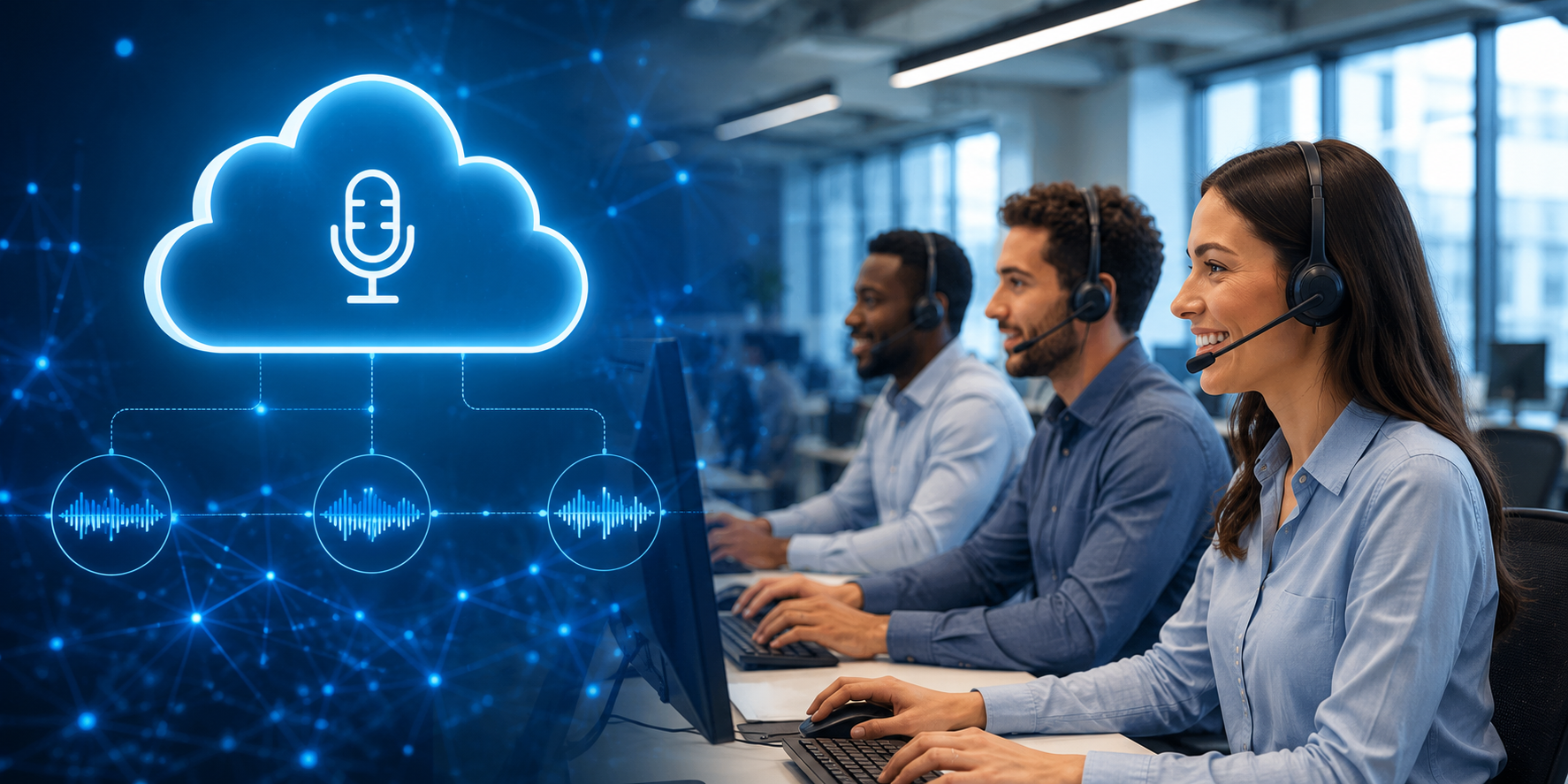
The evolution of call recording
Call recording used to be associated almost exclusively with financial institutions, emergency dispatch centers, and large enterprise support operations, industries with regulatory requirements or high call volumes that justified expensive voice-logging hardware. As VoIP phone systems became the norm, recording shifted from specialized equipment to a software feature built directly into the platform. A modern hosted phone system can automatically record inbound and outbound calls, encrypt and store them securely, and make them searchable through a web portal or mobile app, all without a server closet dedicated to the task.
That shift matters because it puts enterprise-grade documentation within reach of organizations that never could have justified the old cost. A five-line restaurant and a fifty-seat contact center can now run on the same underlying recording infrastructure.
Why contact centers depend on call recording
Contact centers and customer service teams remain the largest users of call recording, for a simple reason: when hundreds of conversations happen every day, management needs an objective record of what actually occurred instead of relying on memory or conflicting accounts.
Quality assurance
Supervisors review real calls to evaluate professionalism, product knowledge, procedure compliance, and problem-solving, then coach based on what actually happened.
Employee training
New hires learn faster from real greetings, real objection handling, and real de-escalation than from a training manual alone.
First call resolution
Reviewing recordings surfaces recurring knowledge gaps and process failures that cause repeat calls, so they can actually get fixed.
Dispute resolution
When a customer and an employee remember a conversation differently, the recording settles it, protecting both sides.
Sales coaching
Recorded calls reveal what closes deals and what loses them, so successful techniques can be replicated across the team.
Accountability
Employees and customers both benefit when service levels can be verified fairly instead of argued about after the fact.
Contact center platforms like Talkdesk and Nextiva both point to the same conclusion from their own customer data: recorded calls consistently improve coaching quality and shorten the time it takes to resolve a customer dispute, because the conversation itself becomes the record instead of a summary written after the fact.
Call recording and compliance
Many industries operate under regulations that effectively require documentation of customer communications, including financial services, insurance, healthcare, government agencies, public safety, legal services, and utilities. For these organizations, a call recording can serve as evidence that a policy, disclosure, or agreement was actually communicated.
Recording laws themselves vary by state and are separate from any industry regulation. Some states require only one party to the call to consent to recording. Others require every party on the call to consent. North Carolina, where Carolina Digital Phone is based, is a one-party consent state under N.C. Gen. Stat. § 15A-287, meaning a business can record a call it is a party to. Other states, including California and Florida, require all-party consent, and recording without it can carry serious legal consequences. Because these rules vary by jurisdiction and can depend on where the caller is located, not just where your office is, Justia's 50-state survey on recording laws is a useful starting reference, and any organization operating across state lines should confirm its specific obligations with legal counsel.
Many businesses address this by playing a recorded disclosure, "this call may be recorded," before the conversation begins. That single sentence does double duty: it satisfies consent requirements in the states that need it, and it sets an expectation of professionalism on both sides of the call.
The rapid growth of call recording in restaurants
Contact centers have used call recording for decades. One of the fastest-growing adopters today is a much less obvious industry: restaurants. Every day, a busy kitchen phone handles takeout orders, modifications, allergy questions, special preparation requests, and catering inquiries, often during the exact rush when staff have the least time to double-check details.
Picture a customer ordering two large pizzas, extra cheese, no onions, a gluten-free crust, a side salad, and a specific pickup time. If the order arrives wrong, there is often no way to know whether the mistake happened on the phone, in the kitchen, or at pickup, unless the call was recorded. With a recording, a manager can verify exactly what was ordered, what was requested for allergies, and what pickup time was agreed to, turning a he-said-she-said dispute into a two-minute playback.
That matters more than it might seem, because restaurants run on thin margins. A wrong order can mean a free replacement, a refund, wasted food inventory, and a negative review, all from one miscommunication. Reviewing recorded order calls also gives managers a direct way to coach staff on confirming orders, repeating details back to the customer, and verifying contact information before hanging up, the kind of small procedural fix that adds up across hundreds of calls a month.
AI-powered voice technology is accelerating this trend. Voice AI vendors serving the restaurant industry now report accuracy rates in the mid-90s to high-90s percent range under lab conditions, compared to lower accuracy for a human order-taker during a peak rush, though real-world performance typically runs somewhat below lab benchmarks once background noise and call quality are factored in. Whether a restaurant uses an AI answering assistant or a live staff member, a recorded, transcribed call is what makes that kind of accuracy measurable and improvable in the first place.
How modern cloud call recording works
With a hosted VoIP phone system, recording is handled entirely in the cloud rather than on local hardware. The process is straightforward:
- The call is captured digitally the moment it connects.
- The recording is encrypted and stored securely in the cloud.
- Authorized staff access recordings through a web portal or mobile app.
- Recordings can be searched, downloaded, reviewed, or shared according to company policy and retention settings.
Because storage and processing happen off-site, there is no on-premise recording server to maintain, back up, or eventually replace.
Why businesses are moving away from legacy recording systems
| Category | Legacy on-premise recording | Cloud-based recording |
|---|---|---|
| Hardware | Dedicated recording servers and storage arrays | None required, storage is cloud-hosted |
| Maintenance | Specialized software and IT upkeep | Maintained by the phone system provider |
| Accessibility | Often limited to on-site playback | Web portal and mobile access from anywhere |
| Scalability | Capacity limited by physical storage | Scales with the business, no new hardware |
| Disaster recovery | Recordings vulnerable to local outages or damage | Stored across resilient cloud infrastructure |
| Cost | Upfront capital investment plus ongoing upkeep | Often included in the monthly phone system cost |
The future of call recording
Call recording is evolving well beyond simply storing audio files. Modern platforms increasingly pair recordings with automated transcription, sentiment analysis, keyword detection, and conversation analytics, turning every call into a searchable, measurable business record rather than an audio file that only gets reviewed after a complaint. Paired with an AI receptionist or AI-powered call handling, recorded and transcribed conversations become a feedback loop: the system can flag missed information, confirm order or appointment details, and help supervisors coach faster because they are not listening to hours of routine calls to find the ones that matter.
Whether you run a customer service department, a sales team, a professional office, a healthcare practice, an insurance agency, a restaurant, or a multi-location business, recorded calls give you an objective record that protects both your team and your customers. If you want to see how this fits into a broader phone system, read more about why organizations choose Carolina Digital Phone, our roundup of business phone systems with auto attendant, or how we help insurance agencies and public-sector organizations meet documentation needs specific to their industry. If call authenticity and trust matter to your business too, our guide to STIR/SHAKEN caller ID authentication covers the other half of making sure every call is what it claims to be.
Want to see call recording running on your own account before you switch? Call ☎ (336) 544-4000 and a local pre-sales engineer will walk through it, no obligation.
Business call recording: frequently asked questions
Yes. North Carolina is a one-party consent state under N.C. Gen. Stat. § 15A-287, meaning a business can record a call it is a party to without separately notifying the other side. Businesses operating in other states should check that state's specific consent requirements, since several states require all-party consent.
No. Call recording is included at no additional cost on many Carolina Digital Phone hosted cloud phone system deployments, rather than sold as a separate premium add-on.
Recorded order calls let managers verify exactly what a customer ordered, including special instructions and allergy requests, which reduces disputes, food waste, refunds, and negative reviews from order mistakes.
Retention settings vary by plan and by company policy. Cloud-based recording removes the physical storage limits of on-premise systems, so businesses can generally set retention windows based on their own operational and compliance needs.
Yes, and it is one of the most common uses. Real customer conversations, both strong examples and ones that went poorly, are often more effective training material than a scripted manual.
No. Cloud-based call recording is built into the hosted phone platform itself. Calls are captured, encrypted, and stored in the cloud, with no on-premise recording server required.
Give your team an objective record of every call.
Quality assurance, training, dispute resolution, and order accuracy, all built into your hosted phone system at no extra cost. Local North Carolina support included.
Request a free consultation