Published October 5, 2026. Last updated October 5, 2026.
Quick answer: why does doing business with local partners matter?
Because you can know the people behind the service, and they can know you. A local partner is accountable in a way a distant one is not. Problems get solved faster, the money you spend stays in your community, and both companies have a stake in the same place. Carolina Digital Phone in Greensboro works with Bandwidth, a public cloud communications company headquartered in Raleigh, as one of the wholesale carriers behind its voice and messaging service. Two North Carolina technology companies, founded a year apart, doing business face to face.
- Wholesale carrier
- A company that owns or operates the underlying voice and messaging network and sells access to other providers. Your phone company has phone companies too.
- The carrier behind the carrier
- A wholesale provider whose network quietly powers the calling and texting inside apps and services you already use.
- Call termination
- Delivering a call to the number that was dialed, across whatever networks sit between the caller and the person answering.
- Call routing
- The decisions a network makes about which path a call takes to get where it is going.
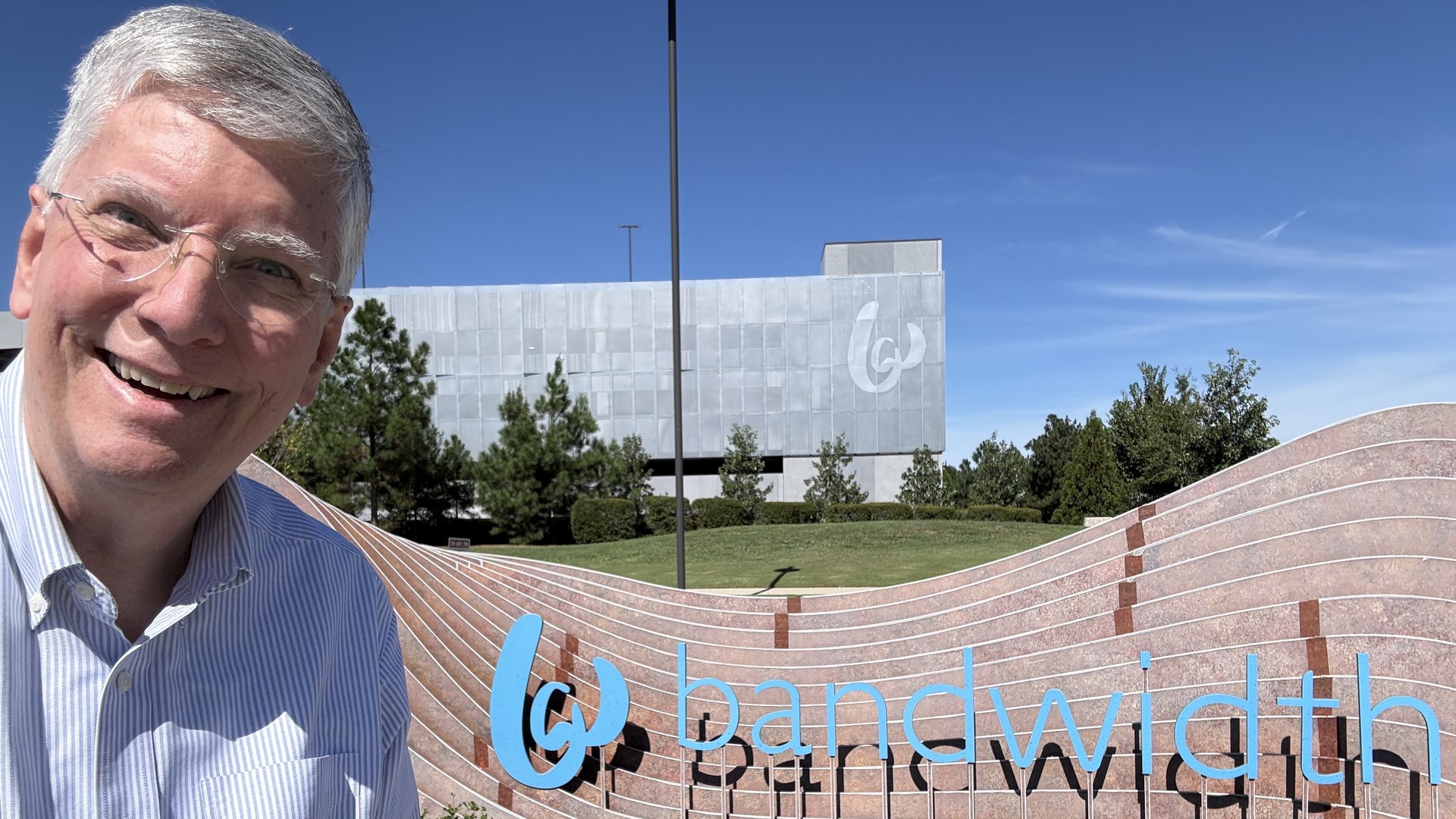
There is a picture at the top of this page of a man grinning like a tourist next to a sign. That is me, in Raleigh, outside the world headquarters of Bandwidth. I have been in technology for more than forty-five years and I still take the picture.
I was there to do something that has become rare in my industry. I went to meet, face to face, the management team and the engineers who support the back-end call routing our customers depend on every day. Not a video call. Not a ticket. A handshake.
Local Business VoIP is the small-business site of Carolina Digital Phone, Inc., the Greensboro company my team and I have run since 2000. We ask North Carolina businesses to trust a local provider with their phones. It would be strange if we did not hold ourselves to the same idea. So this is a story about a visit, about a neighbor, and about a state that has quietly been a technology hub for longer than most people realize.
Who is Bandwidth, and what do they do for Carolina Digital Phone?
Bandwidth is one of the wholesale carriers behind our service, and it is a genuine North Carolina success story. When you make a call on a Carolina Digital Phone system, that call has to travel across carrier networks to reach the person you dialed. Bandwidth is one of the companies we rely on for voice, messaging, call termination, and the carrier services that sit underneath everything we do.
Most people have never heard of them, and that is by design. Bandwidth is often the carrier behind the carrier. Its network supplies the phone numbers, calling, texting, and emergency services inside platforms and apps that people use every day without ever seeing the Bandwidth name.
The facts are worth knowing, because they are impressive for a company an hour and a half down the interstate from our office:
- Founded in 1999 by David Morken, who is still chief executive and chairman. Henry Kaestner joined as co-founder in 2001.
- Headquartered in Raleigh, with offices beyond North Carolina, including Denver and Rochester.
- Publicly traded on Nasdaq under the symbol BAND since November 10, 2017.
- About 1,100 employees, whom the company calls Bandmates. That makes it one of Raleigh's significant technology employers.
- Revenue of roughly three quarters of a billion dollars. The company reported about $748 million for 2024 and $754 million for 2025.
- Still growing. In April 2026, Bandwidth reported a record first quarter, with revenue up 20 percent year over year, and raised its full-year outlook to between $880 million and $900 million.
Those figures come from the company's own public filings on its investor relations site, and they change every quarter, so treat them as a snapshot. The point is not the exact number. The point is that a company of that size, serving customers around the world, chose to build itself here.
It also happens to be the same age as we are, give or take a year. Bandwidth started in 1999. Carolina Digital Phone started in 2000. Two North Carolina companies betting on the same idea at the same time: that voice was going to move onto the internet, and that somebody ought to do it well.
Why does meeting face to face still matter?
Because trust is built between people, not between logos. I have a simple rule that I have followed my whole career. People do business with those they know, like, and trust. You cannot fully know someone through a support portal.
On this visit I sat down with members of Bandwidth's management team and with the engineers who support our call routing. These are the people whose work decides whether a call from a customer in Asheboro reaches a dentist's office in Burlington on the first try. I wanted to see where they work, hear how they think, and put faces to the names in my inbox.
That matters for a practical reason. Every technology company has a bad day eventually. When it comes, the difference between a short problem and a long one is almost always a relationship. Now when a routing question comes up, there are names and faces on both ends of the conversation. That is worth the trip.
It also matters for a reason that is harder to measure. As more business communication is handled by software and artificial intelligence, the human parts become more valuable, not less. A handshake is not efficient. That is exactly why it means something.
Why is North Carolina a technology hub?
Because the state decided to become one more than sixty years ago, and then kept at it. People sometimes talk about North Carolina technology as if it were a recent discovery. It is not. It is the result of one of the most deliberate economic bets any state has ever made.
In 1959, business, government, and university leaders created Research Triangle Park on farmland between Raleigh, Durham, and Chapel Hill. The idea was to move the state beyond agriculture, textiles, and furniture by putting industry next to its universities. The first few years were slow. Then in 1965 IBM announced a large facility there, and the word was out. Today the park covers about 7,000 acres and hosts more than 300 companies.
Two details from that story make me smile, because they are closer to home than Raleigh. According to NCpedia's history of the park, the money to buy the land was raised by Archie Davis of Wachovia, the Winston-Salem bank, who traveled the state asking North Carolinians to invest in their own future. And the name "Research Triangle" is widely credited to Romeo Guest, a construction executive from Greensboro. The Triad had a hand in the Triangle from the very start.
| Year | North Carolina technology milestone |
|---|---|
| 1959 | Research Triangle Park is founded between Raleigh, Durham, and Chapel Hill |
| 1965 | IBM announces a major facility in the park, and its growth begins in earnest |
| 1976 | SAS is founded in the Triangle and becomes one of the world's best-known software companies |
| 1980 | MCNC is created, and goes on to build the network that connects the state's schools and universities |
| 1993 | Red Hat is founded and grows into a global open-source software leader based in Raleigh |
| 1999 | Bandwidth is founded |
| 2000 | Carolina Digital Phone begins serving North Carolina businesses from Greensboro |
| 2017 | Bandwidth becomes a public company on Nasdaq |
| 2022 to 2026 | CNBC names North Carolina America's Top State for Business in 2022, 2023, and 2025, and ranks it in the top two for six straight years |
That last row is not ancient history. In July 2026, the Governor's office noted that CNBC ranked North Carolina first in the nation for its economy and second overall for business, the sixth consecutive year in the top two.
I have watched a good part of this happen. Before Carolina Digital Phone, I opened the first Apple store in North Carolina, became the state's first IBM Medallion Reseller, and built one of its early internet service providers. I am not telling you that to boast. I am telling you because I have seen four decades of proof that you do not have to leave this state, or buy from outside it, to get world-class technology. It has been here all along. We wrote about another piece of that story, the network that connects our schools, in our post on the MCNC HERO project.
Why should local businesses partner with local businesses?
Because everyone in the chain does better, including your customers. I can give you four reasons, and none of them are sentimental.
You can hold each other accountable
A vendor across the country can disappoint you and never think about it again. A vendor down the road will see you at the chamber breakfast. That changes behavior. It changes ours. We live here, and our office is at 301 South Elm Street in downtown Greensboro.
Problems get solved faster
When you know who to call, and they know who you are, you skip the first three steps of every support conversation. That is time your business gets back.
The money stays in North Carolina
The U.S. Small Business Administration's 2025 profile of North Carolina counts about 1.1 million small businesses here. They are 99.6 percent of all businesses in the state and employ 1.8 million people. Every dollar one of those businesses spends with another pays a North Carolina salary and supports a North Carolina family. Spend it out of state and it leaves.
You share a stake in the same place
Local companies sponsor the ball teams, serve on the nonprofit boards, and hire the graduates. When your vendor's success is tied to your community's success, their interests and yours point in the same direction.
This is the same argument we make to our own customers in why choose a local VoIP provider. It would be hollow if we made it to you and then sent our own spending somewhere else whenever we had the choice.
Does buying local mean settling for less?
No, and it must never be used as an excuse. "Local" is not a reason to accept second best. It is a reason to expect more, because a local partner has nowhere to hide.
That is what I admire about Bandwidth, and it is the standard we hold ourselves to. They did not become a company with hundreds of millions in revenue because they are from Raleigh. They became one because they are excellent at what they do, and they happen to be from Raleigh. When possible, we like doing business with national providers that are also local. Companies we know, like, and trust. The order matters. Excellent first. Local is what turns excellent into a relationship.
For your business, a commitment to excellence from a local partner should look like this:
- A person answers when you call, and that person can actually help
- They tell you the truth about what their product cannot do
- They show up on site when the job calls for it
- They can tell you who their own suppliers are, and why they chose them
- They have been in business long enough to have a reputation worth protecting
- They give back to the community they earn their living from
What does this mean for your phone service?
It means the chain behind your dial tone is shorter and more personal than you might expect. When you choose Carolina Digital Phone, your service is designed, installed, and supported by a team in Greensboro. Behind that team are carrier partners we have chosen carefully, including one whose engineers I have now met in person in Raleigh.
We also do not depend on any single company. A well-built phone service uses more than one carrier and more than one data center, so a problem in one place does not become a problem for you. We explained how that works in single-carrier versus multi-carrier VoIP, telecom resilience, and geo-redundant VoIP service.
If you are a North Carolina business owner, here is the question I would leave you with. Look at the five vendors your business depends on most. How many of them could you drive to? How many would recognize you if you did? If the answer is none, it may be worth asking whether a local partner could do the job as well or better. Our guide to business VoIP in North Carolina is a good place to start for your phones, and how to find a local VoIP provider lists what to ask.
You can see what we offer on the phone systems and all-in-one solution pages at Carolina Digital Phone, and read more about who we are on our why Carolina Digital Phone, history, and trusted communications partner pages.
I came home from Raleigh proud of my state. North Carolina built a technology economy on purpose, with money raised from its own people, and it is still producing companies that compete with anyone in the world. We are happy to partner with one of them. And we would be honored to be that kind of partner to you.
Frequently asked questions
Who is Bandwidth?
Bandwidth is a publicly traded cloud communications company headquartered in Raleigh, North Carolina. It was founded in 1999 by David Morken and trades on Nasdaq under the symbol BAND. It operates a carrier network that provides voice, messaging, phone numbers, and emergency services to other communications providers and platforms.
Does Carolina Digital Phone use Bandwidth?
Yes. Bandwidth is one of the wholesale carriers Carolina Digital Phone relies on for voice, messaging, call termination, and other carrier services. Carolina Digital Phone designs, installs, and supports the phone service itself from Greensboro, North Carolina.
What is a wholesale carrier?
A wholesale carrier owns or operates the underlying voice and messaging network and sells access to other providers. A business phone company uses one or more wholesale carriers to deliver calls and texts to their destinations.
Why does doing business with local vendors matter?
Local vendors are easier to hold accountable, solve problems faster because both sides know each other, keep spending and jobs in the community, and share a stake in the same place. Local should never mean lower standards. It should mean higher ones, because a local partner's reputation is on the line every day.
Why is North Carolina considered a technology hub?
North Carolina has invested in technology for more than sixty years. Research Triangle Park was founded in 1959, IBM announced a major facility there in 1965, and companies such as SAS, Red Hat, and Bandwidth were founded in the state. CNBC named North Carolina America's Top State for Business in 2022, 2023, and 2025, and ranked it in the top two for six consecutive years through 2026.
Is Carolina Digital Phone a North Carolina company?
Yes. Carolina Digital Phone is headquartered at 301 South Elm Street in Greensboro, North Carolina, and has provided hosted phone service since 2000. It serves businesses, schools, and local governments across North Carolina, South Carolina, and Virginia.
Related guides
Looking for a local partner for your business phones?
Call us. You will reach a person in Greensboro who can tell you plainly what we do, who we work with, and whether we are the right fit. We have served North Carolina businesses, schools, and local governments since 2000.
Call (336) 544-4000 Talk With Our Local TeamWant a quick quote first? Three questions at HostedBusinessTelephone.com, or ask the founder directly at LocalVoIPProvider.com. Learn more at CarolinaDigitalPhone.com, and about our carrier partner at Bandwidth.com.