
Local Business VoIP is the small-business site of Carolina Digital Phone, Inc., a hosted VoIP provider headquartered in Greensboro, North Carolina since 2000. Every so often I like to step back from pricing tables and feature lists and look at where all of this came from. This is one of those posts.
Quick answer
In 1915 American engineers proved twice in one year that a human voice could cross the continent. On January 25, 1915 Alexander Graham Bell in New York spoke to Thomas Watson in San Francisco over the first transcontinental wire line. On September 29, 1915 AT&T and the U.S. Navy sent speech by radio from Arlington, Virginia to Mare Island, California, and on to Hawaii. Both depended on the vacuum tube amplifier, and both set the pattern your hosted VoIP system follows today: one conversation, carried over whatever path is available.
- Transcontinental line
- The 3,400 mile copper circuit between New York and San Francisco, completed in 1914 and opened for service in January 1915.
- Audion (vacuum tube)
- The electronic amplifier that boosted a weak voice signal so it could survive thousands of miles of wire or an open-air radio path.
- Hosted VoIP
- A business phone service that carries calls over the internet from a provider's data center, so the same number works on a desk phone, computer and cell phone.
1915: the year a voice first crossed America. A short clip from Carolina Digital Phone.
What happened on January 25, 1915?
On January 25, 1915 Alexander Graham Bell sat at a table in New York City, picked up a telephone and spoke to his old assistant Thomas Watson, who was sitting in San Francisco. It was the ceremonial opening of the first transcontinental telephone line, a 3,400 mile copper circuit that AT&T had finished stringing across the country in the summer of 1914 and then held back until the Panama-Pacific International Exposition was ready to celebrate it.
Bell repeated a version of the sentence that started it all in 1876: "Mr. Watson, come here. I want you." Watson, who had rushed into Bell's Boston workshop that first time, answered that it would now take him about a week to get there. The room laughed. President Woodrow Wilson joined from the White House. AT&T president Theodore Vail, recovering from an injury, took part from Jekyll Island, Georgia. The Library of Congress still marks the date, and the photograph below, taken that day by Underwood & Underwood in New York, shows Bell at the center of the table with the candlestick telephone in front of him.
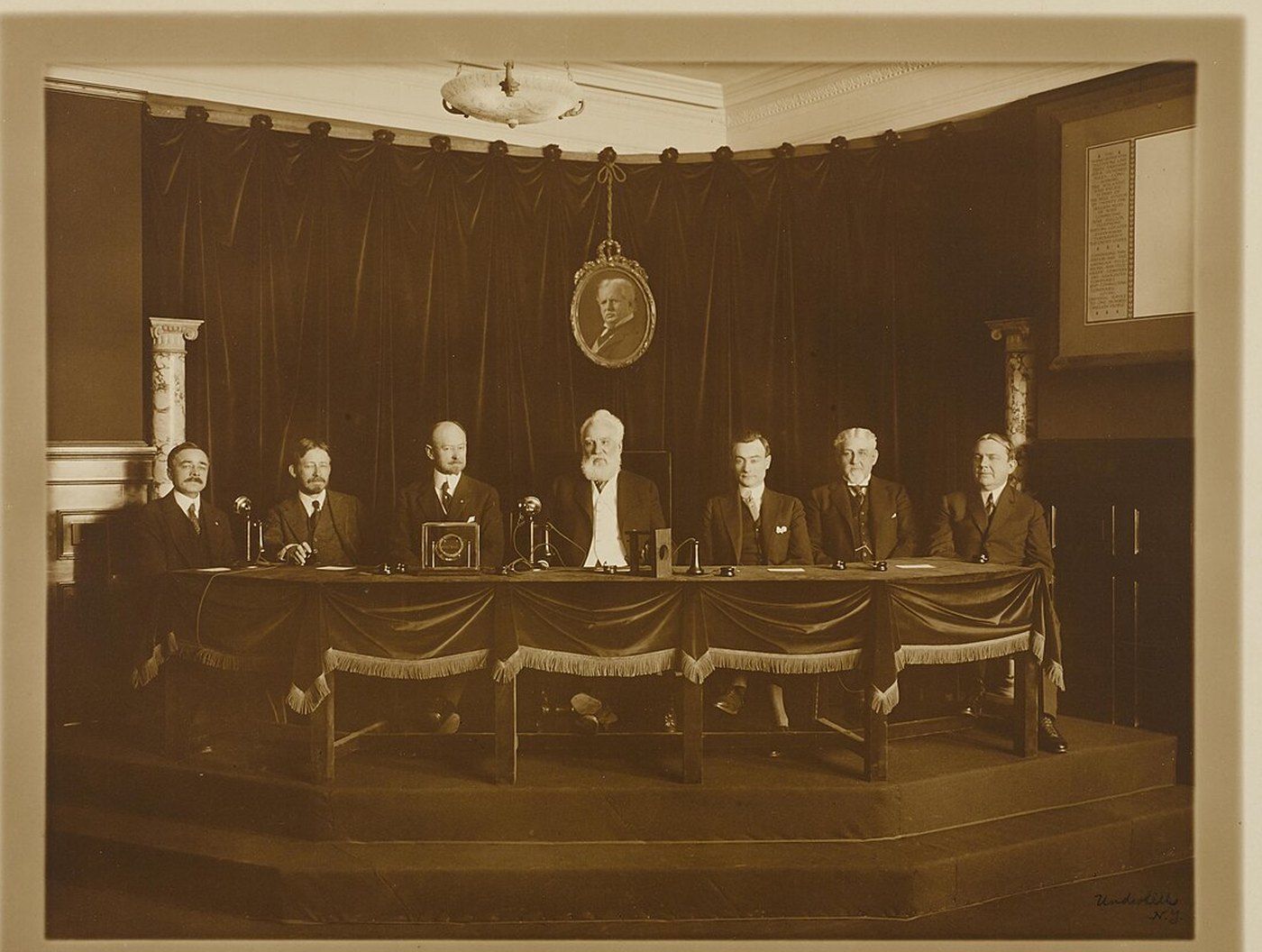
What made the call possible was not the wire. Copper had reached the Pacific long before 1915. The problem was that a voice fades. Push it a few hundred miles and it becomes a whisper, then nothing. Engineers had stretched the practical limit with loading coils, which were basically weights that kept the signal from leaking away, but Denver was about as far as a conversation could go from New York. The breakthrough was the vacuum tube amplifier, developed from Lee de Forest's audion and refined by AT&T's engineers under Harold Arnold. Tube repeaters placed along the route at Pittsburgh, Omaha and Salt Lake City gave the signal a fresh push each time it started to fade. The IEEE recognizes the 1915 line as an engineering milestone for exactly that reason.
What happened on September 29, 1915?
Eight months later the same company did something that got far less attention and arguably mattered more. On September 29, 1915 AT&T, its manufacturing arm Western Electric and the U.S. Navy carried the first successful American transcontinental radio telephone conversation. Speech left New York on an ordinary land line, traveled to the Navy's high-power radio station at Arlington, Virginia, and there was handed off automatically to the radio transmitter. About 2,500 miles away at the naval station on Mare Island, California, near San Francisco, the voice came through clearly. The reply came back over the wire line that Bell had opened in January.
Theodore Vail spoke from New York. AT&T's chief engineer John J. Carty was listening at Mare Island. Contemporary accounts record Vail opening with something close to "Hello, Carty, this is Mr. Vail," and Carty answering that the connection was fine and wonderful. Navy officers, including Captain W. H. G. Bullard at Arlington, talked directly with their counterparts on the West Coast. Within days the signal was also picked up at Pearl Harbor in Hawaii, somewhere between 4,600 and 4,900 miles from Arlington, the longest distance a spoken conversation had ever traveled through the air.
Secretary of the Navy Josephus Daniels, a North Carolinian from Raleigh who published the News & Observer, announced the result publicly and pointed out what it meant for ships at sea. The same Arlington equipment was used a few weeks later, in October 1915, for the first transatlantic radio telephone tests to the Eiffel Tower in Paris. The Naval History and Heritage Command and the Smithsonian both hold records of the Arlington station's role in those early tests.
Why do both 1915 calls matter more together than apart?
The January call proved a voice could cross a continent on a fixed path. The September call proved the same voice could leave that path, travel through the air, and rejoin the network on the other side. That second idea, a hybrid of wire and radio with the handoff done automatically, is the real ancestor of every call your business makes today.
| Milestone | Date | Path | Key technology | What it proved |
|---|---|---|---|---|
| First transcontinental wire call | January 25, 1915 | New York to San Francisco, 3,400 miles of copper | Loading coils, vacuum tube repeaters | Distance was no longer the limit for a wired call |
| First transcontinental radio call | September 29, 1915 | New York to Arlington by wire, Arlington to Mare Island by radio, about 2,500 miles, extended to Hawaii | Tube transmitters and amplifiers, automatic wire-to-radio link | A voice could change networks mid-call and still be understood |
| Hosted VoIP today | Every day | Your office internet, your cell carrier, and the provider's carrier network | Software switching, SIP, geo-redundant data centers | One business number works on every device, over whatever path is up |
When a call reaches your office today it may arrive over fiber, bounce off a cell tower to a technician's phone, and end up as a voicemail transcript in someone's email. Nobody on the call thinks about the handoffs. That is the September 1915 idea, carried out a few billion times a day.
A table, a telephone and a 70-year-old who still gets a kick out of it
I have spent 48 years in technology, starting with COBOL in the late 1970s, and I have a soft spot for that Underwood & Underwood photograph. Look at the faces. Nobody is smiling. These were serious men doing something they could not quite believe was going to work, and the dial on the table says more about the era than any caption could. When I show it to younger people on our team at Carolina Digital Phone, the reaction is always the same: "That's it? That's the whole phone?" Yes. That was the whole phone. Everything that made the call possible was hidden in repeater stations hundreds of miles away, which is also true of the phone on your desk right now. The handset is the least interesting part. The network is the product.
Back in 2004 I wrote down five things I try to do every day: laugh, learn, teach, pray and love. Posts like this one cover two of them. I learn something every time I dig into this history, and I get to teach it to you. So thank you for reading this far.
What did it cost to make a coast to coast call in 1915?
The opening rate for a three minute call from New York to San Francisco was $20.70, with each additional minute at $6.75. In 1915 that was roughly two weeks' wages for a factory worker. Adjusted with the Bureau of Labor Statistics inflation calculator, that three minute call cost the equivalent of several hundred dollars today. Only a handful of calls were placed each day, and the operator would call you back when the circuit was ready, which could take an hour.
Compare that with a hosted VoIP seat today. A business user in Greensboro can call San Francisco, Seattle or Toronto as many times as they like for a flat monthly price, and the call sets up in about two seconds. If you have ever wondered why I talk so much about the value of modern business phone service, this is why. We are living on the far end of the most dramatic price drop in the history of commerce, and most businesses still pay for a phone system as if it were 1995. If you want to see what your own office should be paying, our post on transparent VoIP pricing and cost per user breaks it down line by line.
How did the vacuum tube become the cloud?
Every stage between 1915 and your desk is the same story repeated: find a way to amplify, switch or carry a voice more cheaply than before.
1915 to 1950: tubes and operators
Tube repeaters made long distance routine, but every call still went through a human operator or a mechanical switch. The transcontinental line carried a few dozen calls a day. By the 1940s, coaxial cable and microwave radio relays, direct descendants of the Arlington test, carried thousands.
1950 to 1990: transistors and digital switching
The transistor replaced the tube, and electronic switching replaced the operator. Direct distance dialing arrived in 1951. By the 1980s, voices were being digitized and carried as data between switching centers, even though the last mile to your office was still analog copper. That is the era I started in, selling and installing systems for businesses across North Carolina, and I remember when a 24-channel T1 circuit was the most exciting thing a customer could buy.
1990 to today: the internet carries the voice
Voice over IP arrived in the 1990s and became practical for business in the early 2000s, which is when I founded Carolina Digital Phone. Instead of a dedicated circuit, the call is broken into packets and sent over the same internet connection you use for email. The switch is now software running in a data center. Our platform runs from data centers in downtown Greensboro, Research Triangle Park and Dallas, and our calls ride on national carrier networks that happen to be headquartered here in North Carolina. You can read the full story on our history page, and the FCC's VoIP overview explains the technology in plain terms.
Notice the pattern. In 1915 the smart part of the network was in repeater stations you never saw. In 2026 the smart part is in a data center you never see. What you touch, a desk phone, a laptop app or your cell phone running our Digital Voice Plus app, is just the modern candlestick.
Why is the copper line Bell opened in 1915 going away?
Here is the part of the story that affects your business this year. The copper network that grew from the 1915 line is being retired. AT&T has told the FCC it intends to stop selling and eventually stop supporting traditional copper phone service in most of its territory, and the FCC has made it easier for carriers to do so. We covered the North Carolina deadlines in detail at AT&T copper lines may shut off after November 15, 2026.
Most offices moved their main phone lines years ago, but copper is still hiding in places people forget: the fax machine in the back office, the elevator emergency phone, the fire alarm dialer, the credit card terminal at a second location. When the copper goes, those devices go silent unless you have a replacement plan. Our guide to replacing an analog phone system without gaps walks through every one of those devices. If you are not sure what is still on copper in your building, that is exactly the kind of question our local onboarding engineers answer every week.
What does 1915 teach a small business choosing a phone system today?
Three lessons come straight out of that year.
One. Reliability lives in the network, not the handset. Bell's call worked because of repeater stations in Pittsburgh, Omaha and Salt Lake City. Your calls work because of redundant data centers and carrier connections. When you compare providers, ask about the data centers and carriers, not the phone on the desk. Our post on geo-redundant VoIP service explains what to look for.
Two. The best systems join paths instead of choosing one. The September 1915 call linked wire and radio automatically. A good cloud phone system links your office internet, your staff's cell phones and the carrier network the same way, so a storm that knocks out your office internet does not knock out your phone number. Calls simply reroute to cell phones. If you want to see how that works for a team that is rarely at a desk, read our 15-point checklist for remote and hybrid employees.
Three. Local engineers built it, and local engineers still matter. The 1915 line was built by crews who knew every pole between New York and San Francisco. When something went wrong, somebody drove out and fixed it. That is still how we operate at Carolina Digital Phone. When a Triad business calls us, they get a person in Greensboro who has been in buildings like theirs, not a ticket number. I wrote about why that matters and about being a trusted partner for business communications, and the short version is that know, like and trust still beats a national call center.
How do you move from a 1995 phone system to a 2026 one?
It is simpler than most owners expect, and it does not require you to understand anything in this article. The practical path looks like this: a short conversation about how calls flow through your office today, a check of your internet connection, a port of your existing phone numbers so nothing changes for your customers, and a go-live date where the old system and the new one overlap for a few days. Our guide to the business number porting timeline covers the step most people worry about, and the answer is that your number comes with you.
If you would rather talk than read, request a quick callback from a local onboarding engineer at hostedbusinesstelephone.com or localvoipprovider.com, or call us at (336) 544-4000. We will tell you in about fifteen minutes whether a cloud phone system makes sense for your office and what it would cost.
Frequently asked questions
When was the first transcontinental phone call?
The first transcontinental telephone call took place on January 25, 1915. Alexander Graham Bell spoke from New York to Thomas Watson in San Francisco over a copper wire line that AT&T had finished building in 1914. President Woodrow Wilson and AT&T president Theodore Vail also joined the ceremony.
What did Bell say on the first transcontinental call?
Bell repeated a version of his famous 1876 line, "Mr. Watson, come here. I want you." Watson answered that it would now take him about a week to get there, since he was 3,400 miles away in San Francisco.
What happened on September 29, 1915?
On September 29, 1915 AT&T, Western Electric and the U.S. Navy carried the first American transcontinental radio telephone conversation. Speech traveled by land line from New York to the Navy station at Arlington, Virginia, then by radio about 2,500 miles to Mare Island, California. The signal was later received at Pearl Harbor, Hawaii, roughly 4,600 to 4,900 miles away.
What technology made the 1915 calls possible?
Both milestones depended on the vacuum tube, also called the audion, which amplified weak signals. The wire line used loading coils and tube repeaters spaced along the route. The radio test used tube transmitters and amplifiers at Arlington. Without the tube, a voice could not survive a trip across the continent.
Who was on the September 1915 radio call?
AT&T president Theodore N. Vail spoke from New York. AT&T chief engineer John J. Carty listened at Mare Island, California. Navy officers including Captain W. H. G. Bullard took part at Arlington, and Secretary of the Navy Josephus Daniels announced the result.
How is a cloud phone system related to the 1915 calls?
The 1915 engineers linked wire and radio so one voice could use whatever path was available. A hosted VoIP system does the same thing with the internet, mobile networks and carrier voice networks, so your business number works on a desk phone, a computer and a cell phone at the same time.
How much did a transcontinental call cost in 1915?
The published rate for a three minute New York to San Francisco call in 1915 was about $20.70, which is several hundred dollars in today's money. By comparison, a hosted VoIP plan today includes unlimited calling across the United States and Canada for a flat monthly price per user.
Does a cloud phone system still use copper lines?
No. A cloud phone system carries calls over your internet connection to a carrier network. That matters now because AT&T and other carriers are retiring copper lines, and many North Carolina businesses still have analog lines serving fax machines, elevators and alarm panels that need a replacement plan.
Can a small business in North Carolina get the same reliability a national company has?
Yes. Carolina Digital Phone runs its service from data centers in downtown Greensboro, Research Triangle Park and Dallas, with calls carried by national carriers headquartered in North Carolina. A small office gets the same geo-redundant platform that a multi-location company uses.
How do I find out if hosted VoIP is right for my office?
Request a quick callback from a local onboarding engineer at localvoipprovider.com or call (336) 544-4000. In about fifteen minutes you will know what it takes to move your numbers, what the monthly cost will be and whether your internet connection is ready.
A century of progress, one quick callback
Find out what a cloud phone system would cost your office and how your numbers move with you. A local onboarding engineer in Greensboro will call you back.
Request a Quick Callback Call (336) 544-4000