Published October 19, 2026. Last updated October 19, 2026.
I was running an internet company in Greensboro in December 1997 when the state created 336, and I spent that winter explaining to customers why their area code was changing. Carolina Digital Phone has been issuing North Carolina phone numbers to businesses since 2000, through three overlays and the ten-digit dialing that came with them, and I am about to live through a fourth. The questions have not changed much. Which area code am I in? Does it matter which one I get? Can I keep my number? And lately: what is this 451 I keep hearing about?
This guide answers those questions for business owners rather than for trivia. It lists every North Carolina area code and the cities it covers, explains what an overlay is and why your neighbor's number may start with a different code than yours, and walks through how to choose and publish a local number that works for you. Local Business VoIP is the small-business site of Carolina Digital Phone, Inc., a hosted phone provider headquartered in Greensboro. If you want the longer reference version, my team published a North Carolina area codes guide on our main site this week.
Quick answer: which area code should a North Carolina business use?
Use the area code of the community your customers live in, and publish the full ten-digit number. In the Triad that is 336 or 743; in the Triangle 919 or 984; in Charlotte 704 or 980; in the southeast 910 or 472; in the northeast 252; in the mountains 828, with 451 approved to join it. The two codes in each pair cover the same ground and are equal in every technical sense. If you already have a number customers know, keep it and port it. If you are choosing a new one, ask for the older code of the pair, check the number's history, and set your outbound caller ID to match.
- Area code
- The three digits after the country code that identify a numbering region. North Carolina has ten in service and one approved.
- Overlay
- A second area code added to the same region when the first runs out of numbers. Nobody's existing number changes, but local calls require ten digits.
- Rate center
- The smaller geographic unit inside an area code that a number is actually tied to. Porting works within the rate center, which is why a Greensboro number cannot become a Raleigh number.
- Number porting
- Moving your existing number to a new provider. Your number belongs to you, not to the phone company.
The dentist who thought 743 meant "out of town"
In the spring of 2016, a few weeks after new 743 numbers started being handed out in the Triad, a dentist in High Point called me in a state. He had just opened a second office across town, ordered phone service from a national carrier, and received a number beginning with 743. His front desk had taken three calls that morning from patients asking if the new office was in another state. One of them had asked whether it was in Ohio.
I drove over that afternoon. We put a 336 number on the second office that I had held in inventory, pointed the 743 number at the same ring group so nothing printed would break, and set every outbound call from both locations to show the main 336 line. The confusion stopped that week. Ten years later nobody in High Point blinks at a 743 number, and that dentist's practice still answers both. But he taught me something I now tell every customer: callers do not read area codes the way the Utilities Commission does. They read them the way their neighbors do.
This story is a composite drawn from several Carolina Digital Phone customers during the 743 rollout. Names and details have been changed.What are all the North Carolina area codes?
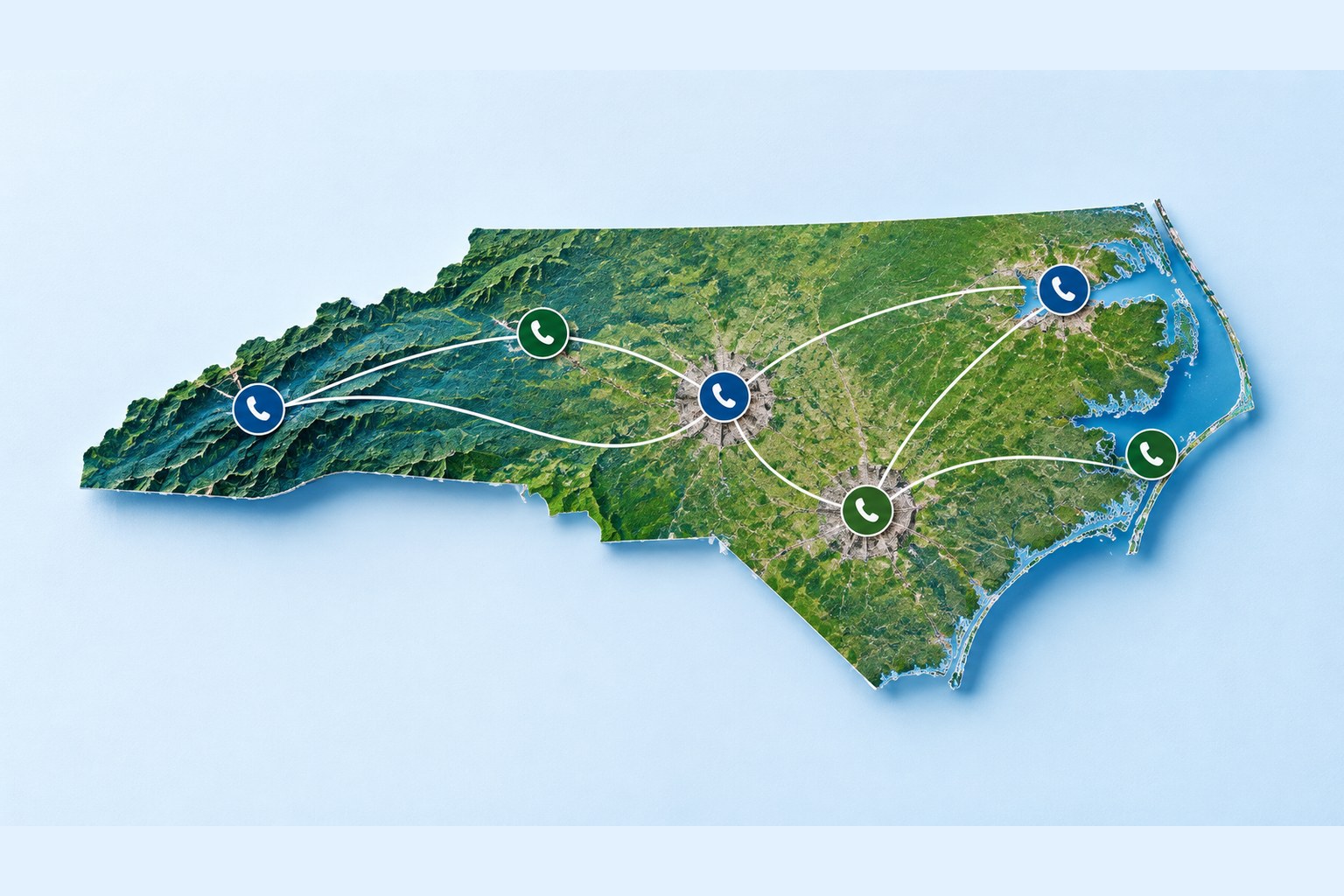
North Carolina has ten active area codes, grouped into six regions, plus one more on the way. The pairs below share territory. A 743 number and a 336 number can belong to offices on the same street.
| Area codes | Region | Cities and towns | History |
|---|---|---|---|
| 336 and 743 | Piedmont Triad | Greensboro, Winston-Salem, High Point, Burlington, Asheboro, Lexington, Mount Airy | 336 split from 910 in 1997; 743 overlay opened in 2016 |
| 919 and 984 | Research Triangle | Raleigh, Durham, Chapel Hill, Cary, Apex | 919 since 1954; 984 overlay opened in 2012 |
| 704 and 980 | Charlotte metro | Charlotte, Concord, Gastonia, Huntersville, Mooresville, Statesville | 704 is the state's original code (1947); 980 overlay opened in 2001 |
| 910 and 472 | Southeast and Sandhills | Wilmington, Fayetteville, Jacksonville, Lumberton, Southern Pines | 910 split from 919 in 1993; 472 overlay opened in 2022 |
| 252 | Northeast and Outer Banks | Greenville, Rocky Mount, New Bern, Elizabeth City, Kitty Hawk | 252 split from 919 in 1998; no overlay yet |
| 828 (451 coming) | Western mountains and foothills | Asheville, Hickory, Hendersonville, Boone, Morganton | 828 split from 704 in 1998; 451 overlay approved September 2026, dates pending |
Exchange boundaries follow the old telephone company service areas, not county lines, so a town near the edge of a region can hold numbers from two different codes. When it matters, the Public Staff of the North Carolina Utilities Commission publishes exchange maps, and the North American Numbering Plan Administrator keeps the official record of every code. For the story of how the state went from one code to ten, read our history of North Carolina area codes.
336 and 743: the Piedmont Triad
Greensboro, Winston-Salem, High Point, Burlington, Asheboro, Lexington, Mount Airy, and the counties around them. 336 was carved out of 910 in December 1997. The 743 overlay opened in May 2016, and ten-digit local dialing became mandatory in the Triad the month before. This is home territory for us, and the region where we hold the deepest inventory of local numbers. If you want to know more about the newer code, our post on where area code 743 is located covers it, and my main-site piece on the slow adoption of 743 in the Triad explains why the dentist in my story was not alone.
919 and 984: the Research Triangle
Raleigh, Durham, Chapel Hill, Cary, Apex, and the surrounding counties. 919 was created in 1954, when the state's original 704 was divided, and has been split twice since, giving up 910 in 1993 and 252 in 1998. The 984 overlay opened in 2012. Because so much of the state's growth is here, 919 numbers are scarcer than 336 numbers; expect to be offered 984 for a new line.
704 and 980: Charlotte and the south-central Piedmont
Charlotte, Concord, Gastonia, Huntersville, Mooresville, Statesville, Salisbury, and much of the region between. 704 is North Carolina's original area code, assigned in 1947 when the state had only one. The 980 overlay opened in 2001, the first overlay in the state, which is why Charlotte callers were dialing ten digits a full fifteen years before the Triad. If you are opening in Charlotte, our Charlotte phone installation guide covers the local details.
910 and 472: the southeast and the Sandhills
Wilmington, Fayetteville, Jacksonville, Lumberton, Southern Pines, Pinehurst, and the coast from Brunswick County north. 910 split from 919 in 1993. The 472 overlay opened in October 2022, so it is the state's newest working code and the one most likely to raise an eyebrow with callers. The North Carolina Utilities Commission's 472 announcement is still the clearest official explanation of how overlays work.
252: the northeast and the Outer Banks
Greenville, Rocky Mount, New Bern, Elizabeth City, Kitty Hawk, and the rest of the northeastern coastal plain. 252 split from 919 in 1998 and is one of only two North Carolina codes still without an overlay, which means seven-digit local dialing still works there. Wilmington is not in 252, a mistake we see on contact lists every month; it belongs to 910/472.
828 and the coming 451: the mountains and foothills
Asheville, Hickory, Hendersonville, Boone, Morganton, Waynesville, and the western quarter of the state. 828 split from 704 in March 1998. This is the region with news. In September 2026 the North Carolina Utilities Commission approved an all-services overlay for 828, and the new code is 451. The numbering administrator forecasts that unassigned 828 numbers run out in the third quarter of 2028, and the standard rollout calls for a permissive dialing period followed by mandatory ten-digit dialing before the first 451 numbers are issued. As of this writing the Commission had not published those dates. Watch ncuc.gov for the schedule, and read the next section if you have an office in the 828 region, because the work starts before the dates do.
Why does my neighbor have a different area code than I do?
Because your region has an overlay, and overlays are the reason the two of you did not have to change numbers. When an area code runs low, the Commission has two choices. It can split the region, which forces half the businesses to reprint everything, or it can lay a second code over the same territory so that existing numbers stay put and only new lines receive the new code. North Carolina has chosen overlays every time since 2001, and so has nearly every state.
The price of an overlay is ten-digit dialing. Once two codes share a region, the switch cannot tell whether 555-1234 means 336-555-1234 or 743-555-1234, so every local call needs all ten digits. The upside is that your number never changes. The downside, for a business, is that every printed seven-digit number becomes a dead end overnight. Signs, truck lettering, the voicemail greeting you recorded in 2009, the fax cover sheet nobody has looked at in years. Every one of them has to carry the area code.
What should an 828 business do about the 451 overlay now?
Four things, none of which require waiting for the Commission's dates:
- Find every seven-digit number you have published and plan to add 828 in front of it. Start with the ones that are expensive to change, such as signs and vehicle wraps.
- Inventory everything that dials for you. Alarm panels, elevator phones, medical alert devices, gate controllers, fax machines, and any old phone system with speed dials. Each one that stores a seven-digit number will need reprogramming before ten-digit dialing becomes mandatory.
- Decide whether you want more 828 numbers before they run out. If a second location, a dedicated service line, or a tracking number is in your plans, ordering it in 2027 gets you 828. Ordering it in 2029 probably gets you 451.
- If you are on a legacy phone system, ask whether it can even handle ten-digit local dialing. Some cannot. That question has pushed more than one mountain business onto a hosted VoIP service ahead of schedule.
Does the area code matter for a business phone number?
Yes, in two ways, and no in a third.
It matters to callers. People answer local numbers and screen unfamiliar ones. A customer in Winston-Salem will pick up a 336 call from a number they do not recognize far more readily than a toll-free number or an out-of-state code. If you serve more than one region, a local number in each one is cheap insurance; a Triad contractor who also works the Triangle should publish both a 336 number and a 919 number, and a hosted phone system can ring them both to the same desk. Our guide to what a VoIP number is explains how a number stops being tied to a wire.
It matters for search. Google Business Profile, Apple Maps, Yelp, and the data aggregators that feed them use the phone number as one signal that a business is where it says it is. A local number that matches the listing address reinforces the listing. A mismatched number does not break anything, but it does not help.
It does not matter technically. A 743 number and a 336 number route identically, cost the same, port the same, and show the same on caller ID. The only real difference is age, which is why some business owners still ask for the older code. If the older code is available, we give it to them. If it is not, we tell them the truth: nobody in the Triad has thought 743 was Ohio in a very long time.
Which North Carolina area codes still have numbers available?
| Region | Older code | What a new line usually gets |
|---|---|---|
| Triad | 336 | Either 336 or 743, depending on the rate center and the provider's inventory. Ask for 336. |
| Triangle | 919 | Usually 984. Some providers still hold 919 blocks in smaller rate centers. |
| Charlotte | 704 | Either, though 980 is now common. 704 is available in outlying towns more often than in the city. |
| Southeast | 910 | Mostly 910 still; 472 only where a rate center has exhausted its 910 blocks. |
| Northeast | 252 | 252. No overlay yet. |
| Mountains | 828 | 828 until the 451 overlay enters service, then either. |
Availability shifts block by block, so treat the table as the pattern rather than a promise. A provider that holds its own number inventory, as we do in the Triad, can usually find the code you want in the rate center you need.
How do you choose a local business phone number in North Carolina?
Here is the order we walk new customers through. The steps are also published as structured data so search engines and AI assistants read them the same way you do.
- Decide where your customers think you arePick the area code of the community you serve, not the one that happens to be free. A Greensboro plumber wants 336. A Raleigh law office wants 919. If you serve two regions, get a number in each.
- Keep the number you already haveIf customers already know your number, port it. Area code and city do not matter for porting as long as the new provider serves that rate center, and a ported number keeps every listing, sign, and business card working.
- Ask for the older code when it is availableA 336 or 919 number reads as more established to some callers than 743 or 984. Supply is limited, so ask. If only the overlay code is available, take it; the two codes are equal in every technical sense.
- Check the number's history before you accept itAsk the provider whether the number was recently in service, search it online, and watch the first week of inbound calls. A number that used to belong to a busy business will bring that business's callers to you.
- Set your outbound caller ID to the number you want callers to seeA hosted phone system can show your main number on every outbound call from every desk and app, so customers see one consistent local number and call it back.
- Publish the full ten-digit number everywhereOverlay regions require ten-digit dialing, so a seven-digit number on a sign or a website is a dead end. Update directories, Google Business Profile, invoices, voicemail greetings, and email signatures.
Step two deserves its own sentence. Keeping your number is almost always the right call, and it is almost always possible. Federal rules require carriers to release a number to a new provider that serves the same area, and that includes moving from a copper landline to a cloud service. The catch is paperwork. The name, address, and account number on the port request have to match the old carrier's records exactly, and you must not cancel the old service until the port completes. Our business number porting timeline guide covers the process week by week, and Carolina Digital Phone's own page on porting your number to a cloud-based provider lists what we ask for.
What can an area code tell you about a caller, and what can it not?
An area code tells you which numbering region issued the number. It tells you nothing certain about where the caller is sitting. A business number on a hosted system rings on a desk phone in Greensboro, a laptop in a Myrtle Beach rental, and a mobile app on I-40 in the same afternoon. The number says Triad; the person is wherever they are. That is a feature for your business, since our Digital Voice Plus app lets your team carry the office number anywhere. It also means the familiar code on your own caller ID should not be mistaken for proof of anything.
Caller ID can be forged, and the forgers know that a local area code gets answered. The Federal Trade Commission's guidance on spoofed calls is plain: a call that asks for money, passwords, or account numbers should be ended and the organization called back at a number you already trust. For your own outbound calls, the mirror image applies. Showing an accurate, registered business number on every call is both the law and the reason customers pick up. Our guide to business caller ID rules explains what "registered" means.
A note on the +1. Every North Carolina number written in international format starts with +1. The 1 is the country code shared by the United States, Canada, and the rest of the North American Numbering Plan. It is not an eleventh digit of your number and not an area code, but it belongs on your website if you have customers who dial from a mobile phone, because a phone recognizes +1 336 555 0100 as a tappable link in any country.
Why get your North Carolina number from a North Carolina provider?
Any carrier in the country can sell you a 336 number. Not every carrier can tell you that the rate center you asked for is actually Kernersville, that the number they just offered you belonged to a bail bondsman until March, or that your old PBX will choke on ten-digit dialing. We can, because we have been doing this in this state since 2000, from an office on South Elm Street in Greensboro, with wholesale carriers headquartered in Raleigh. That is the point of our page on why businesses choose Carolina Digital Phone, and of the two decades described in our history. We have stayed a trusted communications partner to Triad businesses through two area code changes, and we will walk mountain businesses through the third.
If your business is anywhere in the state, our business VoIP in North Carolina page explains what hosted service looks like in your region. If you are in Greensboro, start with hosted PBX in Greensboro.
Frequently asked questions about North Carolina area codes
How many area codes does North Carolina have?
North Carolina has ten active area codes: 252, 336, 472, 704, 743, 828, 910, 919, 980, and 984. An eleventh, 451, has been approved as an overlay for the 828 region and will enter service once the North Carolina Utilities Commission sets the dates.
What is the area code for Greensboro and Winston-Salem?
Greensboro, Winston-Salem, High Point, and the rest of the Piedmont Triad use 336 and its overlay 743. Both codes cover the same territory, so a 743 number is just as local as a 336 number.
What is the difference between 336 and 743?
Nothing geographic. 743 was added in 2016 as an overlay because 336 was running out of numbers. New lines in the Triad may receive either code. A 336 number is simply older on average, which is why some businesses prefer it.
What is an area code overlay?
An overlay adds a second area code to the same geographic region instead of splitting the region in two. Existing customers keep their numbers, new customers may receive either code, and everyone must dial ten digits for local calls.
Is the 828 area code getting a new overlay?
Yes. In September 2026 the North Carolina Utilities Commission approved 451 as an all-services overlay for the 828 region, which covers Asheville, Hickory, Boone, and the western mountains. The industry forecast is that 828 numbers run out in the third quarter of 2028, and the dates for ten-digit dialing and the first 451 assignments had not been published when this guide was written.
Do I have to dial the area code for local calls in North Carolina?
In every overlay region, yes: 336/743, 919/984, 704/980, and 910/472 require ten-digit local dialing. The 252 region and the 828 region still allow seven-digit local dialing until an overlay arrives. Once 451 enters service, 828 callers will need to dial ten digits too.
Can a business in North Carolina get a phone number in a different area code?
Yes. With a hosted VoIP provider you can hold a local number in any rate center the provider serves, so a Charlotte business can answer a 336 number for its Greensboro customers, or a Triad firm can publish a 919 number for a Raleigh office it has not opened yet. The number rings wherever you set it to ring.
Can I keep my North Carolina phone number if I switch phone companies?
Almost always. Federal rules let you port a number to a new provider that serves the same geographic area, including from a landline to a VoIP service. Do not cancel the old service until the port completes, and make sure the account name, address, and account number on the port request match the old carrier's records exactly.
Does a 743 or 984 number hurt a business?
Not in our experience. Callers in overlay regions have had years to get used to both codes. What hurts a business is a number nobody can read, a seven-digit listing in a ten-digit region, or an outbound caller ID that shows a different number from the one on the sign.
Is the +1 in front of a North Carolina number an area code?
No. The 1 is the country code for the United States, Canada, and the rest of the North American Numbering Plan. A complete North Carolina number is the country code, the three-digit area code, and the seven-digit local number.
Can I tell where a caller is from the area code?
Only roughly. The area code tells you which numbering region issued the number, not where the phone is right now. A business line can ring on a mobile app in another state, and caller ID can be faked. For any call that asks for money or account details, hang up and call the organization back at a number you already trust.
Which provider should a North Carolina business use for a local number?
One that serves every rate center you care about, can port the numbers you already have without downtime, and answers the phone locally when something goes wrong. Carolina Digital Phone has provided local numbers and hosted phone service to North Carolina businesses since 2000, from its headquarters in Greensboro, through wholesale carriers headquartered in Raleigh.
Need a local number, or need to keep the one you have?
Tell us the area code and the town. A local onboarding engineer will call you back, check what is available in your rate center, and explain how to port the numbers you already have without a day of downtime. No sales pitch, no long-term contract.
Check Local Number Availability Get a Quick CallbackOr call Carolina Digital Phone at (336) 544-4000.