Posted by Carolina Digital Phone, hosted business phone service in Greensboro, NC since 2000.
Telephones for business are communication systems that manage voice calls, text messaging, and video meetings through a single platform, most often delivered over the internet. For small businesses in North Carolina, from a law office in Raleigh to a contractor in Winston-Salem, the right business phone system is the operating system for your communications. Modern business phones run on Voice over Internet Protocol, or VoIP, which converts voice into digital packets sent over your internet connection instead of copper phone lines. That shift from analog to digital is what makes today's systems so much more capable and affordable than traditional landlines.
What types of telephones for business are available?
Three main categories cover most small business needs: traditional landlines, hosted VoIP systems, and virtual phone services. Each works differently, costs differently, and fits different situations.
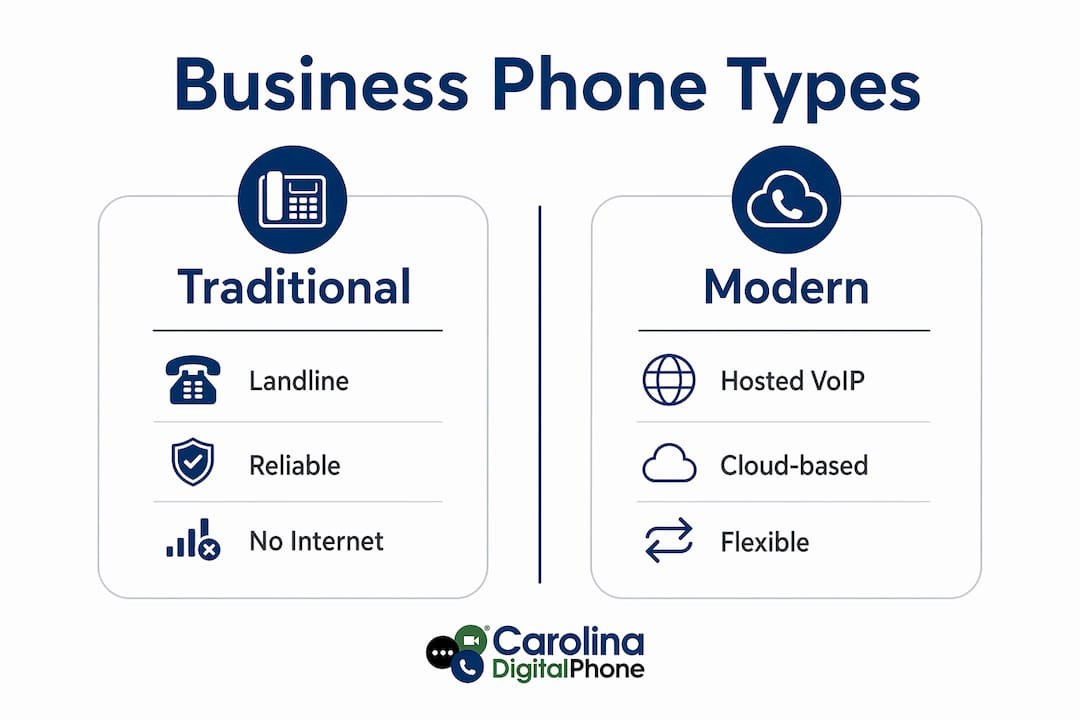
Traditional landlines use the Public Switched Telephone Network, the PSTN. They are reliable and familiar, but they require physical wiring, on-site hardware, and a local phone company contract. Adding lines means paying an installer. Features like call recording or auto attendants cost extra and often require a separate PBX box on your premises. For most North Carolina small businesses, the upfront cost and limited flexibility make landlines a poor fit in 2026.

Hosted VoIP systems are the current standard for small businesses. Your provider hosts all the call-routing software in the cloud, and your team uses desk phones, computers, or mobile apps to make and receive calls. Unified communications platforms combine phone, video conferencing, team messaging, and app integrations in one cloud system. That means your receptionist, your field crew, and your remote employees all work from the same phone system without being in the same building. If you want the deeper technical picture, our page on what hosted VoIP is and how it works covers it in plain language.
Virtual phone services take a lighter approach. They forward calls to existing mobile devices and add a business number on top of your personal cell plan. You get voicemail, basic call routing, and a professional caller ID. What you give up is the deeper call management that growing teams need, such as call queues, ring groups, and detailed reporting. We compared this approach in depth in our Carolina Digital Phone versus Google Voice breakdown.
| System type | Best for | Key limitation |
|---|---|---|
| Traditional landline | Businesses with no internet | High cost, limited features |
| Hosted VoIP | Teams of any size needing full features | Requires reliable internet |
| Virtual phone service | Solo operators or very small startups | Fewer advanced features |
The right choice depends on your team size and how you handle calls. Startups often prefer virtual apps, while growing teams benefit from hosted VoIP with centralized call management.
What features should you look for in business phones?
The best office phones do more than ring. The features you choose shape how your customers experience your business every time they call.
Core call management tools
- Call forwarding and ring groups: Route calls to the right person or team automatically, so no customer waits on hold unnecessarily.
- Auto attendant: A recorded menu greets callers and directs them without a live receptionist. This alone projects a professional image for a two-person shop.
- Call queues: Hold callers in line during busy periods and play hold music or messages instead of sending them to voicemail.
- Voicemail to email: Converts voicemail recordings to audio files sent directly to your inbox, so you never miss a message.
Advanced features that separate a phone plan from a platform
Top VoIP platforms now bundle AI features like call transcription, automatic call summaries, and AI receptionists that answer around the clock. That means after a sales call, your system can hand you a written summary of what was discussed, and a caller at 9 pm still gets helped instead of a voicemail box. For a small business owner juggling ten things at once, that is a real time saver. Our AI Agent page shows what this looks like in practice.
Integrations with CRM tools, calendars, and email connect your phone system to the rest of your business software. When a customer calls, their account history can pop up on your screen automatically. That kind of context makes every conversation more personal and more productive.
How much do telephones for business typically cost?
Cost is where many small business owners get surprised. The pricing range is wide, and the final number depends on which system type, feature tier, and billing structure you choose.
Standard VoIP service runs $10 to $60 per user per month, with annual billing discounts available from most providers. That range is meaningful. A five-person team on a basic plan might pay $50 per month total. The same team on an enterprise tier with AI features and unlimited international calling could pay $300 per month or more.
Key cost factors to weigh
- Hardware: Desk phones range from $50 to $300 per unit. Many businesses skip physical phones entirely and use softphone apps on laptops and cell phones, which cuts hardware costs to zero.
- Add-ons: AI transcription, call recording storage, and international calling are often sold separately. Always ask what is included in the base price.
- Contract length: Month-to-month plans cost more per user but give you flexibility. Annual contracts lower your monthly rate but lock you in.
- Number of users: Most VoIP plans charge per user, so your bill grows as your team grows. Confirm the per-user rate before you scale.
Transparent pricing matters more than a low headline number. A plan advertised at $15 per user per month can balloon with add-on fees. Carolina Digital Phone publishes honest pricing with no surprise charges, and we absorb the taxes and regulatory fees instead of bolting them onto your invoice later, which is exactly what a North Carolina small business needs when managing a tight budget.
How to choose the right phone system for your small business
Choosing a business phone system is a process, not a purchase. Work through these steps before you commit.
- Count your users and call volume. A solo accountant and a 20-person HVAC company have very different needs. Know how many people need a line and how many calls you handle daily.
- Map your remote and mobile workers. If your team works from job sites, home offices, or on the road, you need a system with a strong mobile app. Hosted VoIP handles this well. Traditional landlines do not.
- List the features you actually need. Write down your must-haves, such as an auto attendant, call recording, and conferencing, and your nice-to-haves, such as AI summaries and CRM integration. This list protects you from paying for features you will never use.
- Check your internet connection. Inadequate internet bandwidth causes call quality issues regardless of how good your phone system is. Run a speed test and confirm your connection can handle VoIP traffic before you sign up.
- Ask about uptime guarantees and support. A phone system that goes down during business hours costs you customers. Look for providers that publish uptime targets and offer real support from real people, not just a chatbot.
- Request a free trial or demo. Most hosted VoIP providers offer a trial period. Use it. Test call quality, the mobile app, and the admin portal before you pay.
- Plan your number move. Your existing business number can come with you under federal portability rules. Our guide on how to port business numbers without missed calls walks through the whole process.
The real value of a unified VoIP system comes from combining voice, SMS, video, and messaging in one workspace that syncs with your business software. That is not a luxury for large companies. For a small business in North Carolina, it means your team communicates like a much larger organization without the overhead.
Key takeaways
The most effective telephone system for a small business combines hosted VoIP technology, transparent pricing, and features that match your actual call volume and team size.
| Point | Details |
|---|---|
| VoIP is the current standard | Hosted VoIP replaces landlines with cloud-based calling, lower costs, and more features. |
| Features drive real value | Auto attendants, call queues, AI transcription, and CRM integrations improve every customer interaction. |
| Pricing ranges widely | Expect $10 to $60 per user per month; always confirm what is included before signing. |
| Network readiness is non-negotiable | Poor internet bandwidth causes call quality problems regardless of your provider's quality. |
| Match the system to your size | Virtual phone apps suit solo operators; hosted VoIP suits teams that need centralized call management. |
What I have learned after years of watching small businesses choose phone systems
The single biggest mistake I see small business owners make is treating the phone system as a utility purchase, like buying paper clips. They pick the cheapest option, skip the trial, and call it done. Six months later, they are dealing with dropped calls, a billing dispute, and a support line that puts them on hold for 45 minutes.
The phone system is not a commodity. For most small businesses, it is the primary way customers reach you. A bad experience on that first call shapes everything that follows. I have watched businesses in rural North Carolina lose repeat customers simply because their auto attendant was broken and nobody noticed for three weeks.
The other pattern I see is businesses that overbuy. They sign up for an enterprise platform with 60 features and use four of them. They pay for AI analytics on a call volume that does not justify it. The right system is the one that fits your actual operation today, with room to grow when you need it.
VoIP is not going away. AI features in phone systems are getting genuinely useful, not just marketing language. Call transcription and automatic summaries already save real time for small teams. The businesses that treat their phone system as a core operational tool, and invest a little time in choosing the right one, consistently communicate better and retain more customers.
A phone system built for North Carolina small businesses
Small businesses across North Carolina deserve a phone system that works without drama. Carolina Digital Phone delivers hosted VoIP service built for teams that need reliable calls, honest billing, and support from real people who pick up the phone.
Carolina Digital Phone targets 99.99 percent uptime across three geo-redundant data centers and backs that with a North Carolina support team that takes ownership of problems until they are resolved. You get business texting, mobile apps, AI agents, and video calling with no hidden fees. Whether you run a three-person office in Asheboro or a growing service company in Hickory, the plans scale with you.
Ready to upgrade your business phones?
Talk to a local expert about the right phone system for your team size, call volume, and budget. Straight answers, honest pricing, and a demo tailored to your business.
(336) 544-4000 Request a Demo