Business phone companies: a 2026 guide for North Carolina SMBs
Choosing a business phone company in 2026 means sorting real value from marketing noise. This guide breaks down what hosted VoIP providers actually offer, what they truly cost, and how to pick the right fit for your office, call center, and remote teams, written by a North Carolina company with more than 45 years in technology.
Business phone companies supply cloud-based phone systems that combine voice, messaging, video, and AI features into one platform, replacing the traditional landline for growing teams. The industry term is hosted VoIP, short for Voice over Internet Protocol, and for North Carolina small and mid-sized businesses it has become the default choice. The best providers target 99.99% uptime and offer mobile and desktop apps that work on any device. The differences that matter, and the ones that decide whether you are happy in a year, come down to features, reliability, real cost, and who actually answers when something breaks. Here is how to weigh all four.
What business phone companies actually offer
A modern business phone company delivers far more than a dial tone. The core product is a unified communications platform that folds phone, video, chat, and text into a single system, so your team stops juggling a stack of disconnected apps. On top of that foundation, capabilities that used to be premium extras are now standard: AI call transcription, automated coaching prompts, and sentiment scoring. A sales team in Greensboro can review a call summary minutes after hanging up, with no manual note-taking.
Integration depth is what separates the good from the great. When your phone system connects natively to the tools you already live in, like Salesforce, HubSpot, Microsoft Teams, and Google Workspace, every call log and contact record updates itself. And increasingly, mobile and desktop apps replace the desk phone entirely, letting your team call, text, and meet from one app on any laptop or smartphone, which matters most for North Carolina businesses with remote staff or multiple locations. Here is what to expect from a strong provider:
- Unified communications: voice, video, SMS, and team chat in one app
- AI call tools: transcription, coaching prompts, and sentiment scoring
- CRM and app integrations: Salesforce, HubSpot, Microsoft Teams, Google Workspace
- Mobile and desktop softphone apps, with full features and no required desk phone
- A 99.99% uptime target, the industry reliability benchmark
- Business texting: two-way SMS from your business number

How to evaluate and choose a business phone company
Price alone is a poor filter, because the base rate rarely reflects what you will actually pay. Use six criteria instead. Scalability: adding or removing users should take minutes, not a service call. Reliability: ask for a documented uptime figure; the benchmark is 99.99%, under an hour of downtime a year. Unified communications: confirm voice, video, SMS, and chat are included, not sold separately. Cost transparency: request an itemized quote covering international calling, analytics, and integration fees, since hidden costs are the top complaint from businesses that switch. Integrations: verify your daily tools connect natively, not through a fragile workaround. And support quality: call the support line before you commit and time how long it takes to reach a real person. Our deeper guides on choosing a business phone service provider and how to choose a business phone system walk through each of these in detail.
Matching the system to your team: office, call center, and remote
The right fit depends on your team and where your people work. This is also where the return on investment shows up, because a system matched to how you operate pays for itself in saved time and captured calls.
Office teams gain the most from consolidation: one platform for calls, texts, video, and voicemail replaces a closet full of hardware and a pile of separate subscriptions, with CRM integration that ends manual data entry. Call centers and high-volume support desks need smart routing, ring groups, call queues, live analytics, and an AI receptionist to handle overflow, all riding on a platform engineered for uptime so a busy day never becomes a lost day. Remote and hybrid workers get the biggest lifestyle change: mobile and desktop apps let them work from anywhere while showing the business number, not a personal one, with business texting and voicemail-to-email keeping everyone reachable and in sync. One platform, three very different wins.
Sizing matters too. Small teams and solopreneurs need simplicity and mobility, a mobile-first plan with texting, a professional auto attendant, and a local number, without paying for enterprise features they will never touch. Mid-sized businesses of roughly 10 to 100 people need more depth: advanced CRM integrations, AI analytics to coach reps at scale, multi-site support across North Carolina, and flexible billing. True enterprises need custom SLAs and deep API access, which most North Carolina SMBs simply do not need and should not pay for.
Want help matching a system to your exact team and getting the best ROI? Call ☎ (336) 544-4000 and talk with a pre-sales engineer here in North Carolina. No obligation, just a straight, useful conversation.
What business phone companies actually cost
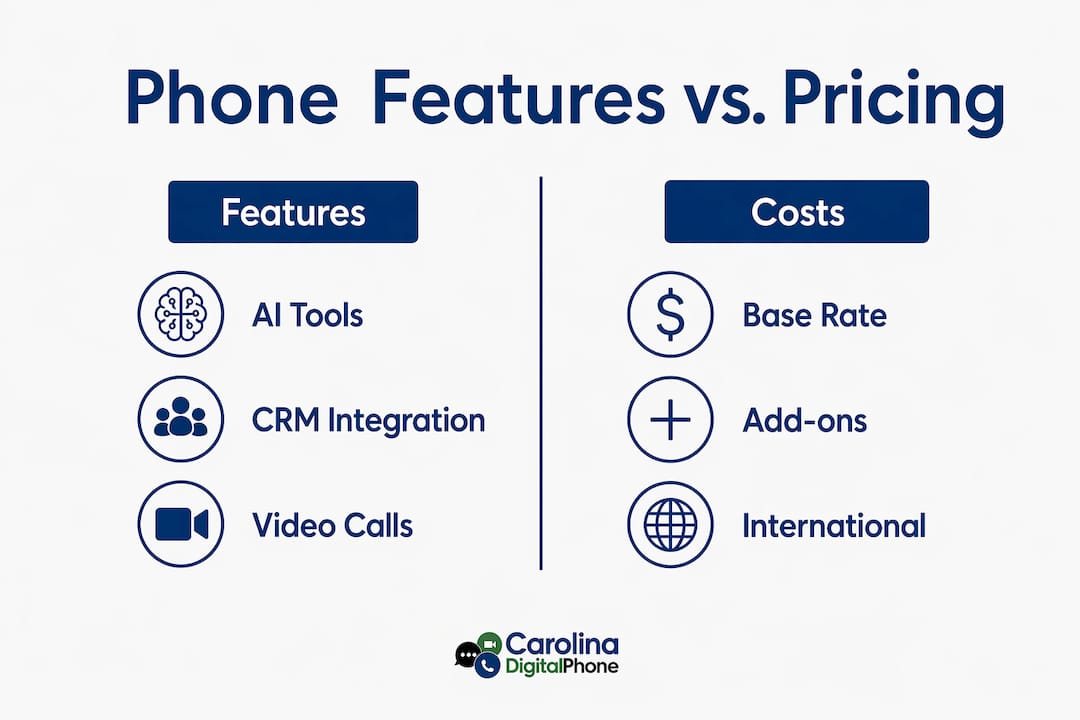
Pricing follows a per-user, per-month model, and cloud VoIP typically runs between $10 and $80 per user each month depending on the feature tier. That range is wide because entry plans and full-featured tiers are priced very differently, and the base rate is rarely the real rate. A plan advertised at $20 per user can reach $45 once you add the analytics, integrations, and international calling a growing business actually needs. The upside is that VoIP still costs far less than traditional lines, because there is no PBX hardware to replace, no technician visits for updates, and no separate contract per location. Our full breakdown of what business VoIP costs and how much you save runs the numbers.
| Cost category | What to watch for |
|---|---|
| Base monthly rate | Often excludes analytics, AI tools, and integrations |
| International calling | Charged per minute or as a separate add-on bundle |
| CRM integration fees | Some providers charge per integration or per user |
| Contract length | Month-to-month costs more; annual plans offer savings |
| Hardware costs | Softphone apps can eliminate desk phone purchases entirely |
An honest read on picking the right vendor
After years of watching North Carolina businesses switch phone systems, the pattern is consistent. Many teams choose on the advertised price and regret it within six months when the real bill arrives. The deeper mistake is treating the phone system as a commodity. It is the operating system for your communications, since every customer call, internal meeting, and sales follow-up runs through it. A provider that cuts corners on support or buries fees in fine print creates problems that surface at the worst possible moment, like when a key client cannot reach you.
The businesses that thrive are the ones that matched the platform to their real workflow rather than chasing every feature on a marketing page. For most teams under 50 seats, simplicity and reliable support beat feature overload every time. There is one question worth asking every provider you consider.
If the answer is a ticket queue or an offshore call center, that tells you how much they value your business. If the answer is a local team that picks up and owns the problem, you have found something rare.
Carolina Digital Phone: your local authority for the next era of communication
North Carolina businesses that want transparent pricing and dependable local support have a direct option in Carolina Digital Phone. We deliver hosted VoIP built for businesses, schools, and government organizations that need reliability without enterprise complexity. Our plans target 99.99% uptime and include business texting, mobile apps, and AI agents as standard, with support routed to a real team in North Carolina and no hidden fees or confusing tiers.
What makes us a genuine local authority is time in the field. Carolina Digital Phone has served North Carolina since 2000, led by a founder whose technology career spans more than 45 years, from the earliest days of business computing through today's AI-driven communications. We have helped local businesses navigate every major shift in this industry, and our job is to help you adopt what genuinely improves your ROI, skip what is just hype, and do it with people who answer the phone. Learn why organizations choose us, read our 45-year story, see our guide to choosing a partner you can trust, or explore how we serve schools, healthcare, and government.
Comparing business phone companies for 2026? Talk to a provider that picks up when something goes wrong. Call ☎ (336) 544-4000 for a no-obligation conversation with an experienced North Carolina engineer, or request a callback.
Business phone companies: frequently asked questions
A hosted VoIP phone system routes calls over the internet instead of traditional phone lines, with all hardware and software managed by the provider. Businesses pay a monthly per-user fee and access calls, messaging, and video through an app on any device. See our full explainer on what hosted VoIP is and how it works.
Cloud-based VoIP plans typically range from $10 to $80 per user per month. The actual cost depends on the feature tier, and base rates often exclude analytics, CRM integrations, and international calling, so always price the full feature set for your real team size.
The industry benchmark is 99.99% uptime, which equals less than one hour of downtime per year. Carolina Digital Phone targets this standard across three geo-redundant data centers and backs it with dedicated local support.
No. Mobile and desktop apps replace traditional desk phones in most modern VoIP setups. Your team can make calls, send texts, and join video meetings from any smartphone or laptop, which is ideal for remote and hybrid workers.
The most widely used integrations are Salesforce, HubSpot, Microsoft Teams, and Google Workspace. Integration depth matters most for teams that rely on CRM-connected calling workflows to manage customer relationships.
Because local support prevents downtime from becoming a business problem. A local team answers faster, knows your setup, and takes ownership until an issue is resolved. Carolina Digital Phone routes every support call to a real North Carolina team. Call (336) 544-4000 to experience it.
Get the best ROI from cloud voice and messaging in 2026.
Whether you run an office, a call center, or a remote team, an experienced Carolina Digital Phone engineer will help you choose hosted voice and messaging that fits your workflow and your budget. Transparent pricing, 99.99% uptime, and a local North Carolina team that answers the phone. No obligation.
Request a free consultation