The short version: a HIPAA-compliant answering service is one that signs a Business Associate Agreement before touching a single patient call, then backs that signature up with encryption, access controls, audit logs, and trained people. The paperwork is federal law. The rest is whether the vendor actually runs their shop the way the paperwork says. Your job is telling the difference.
I want to start with the moment this usually goes wrong, because it is quieter than you'd think.
A practice picks an answering service. The price is fair, the demo went fine, the sales rep said the words "fully HIPAA compliant" at least four times. Somebody signs the service agreement, the practice manager moves on to the next fire, and eighteen months later a question comes up during an insurance renewal or a security review: where's the Business Associate Agreement? And the room goes quiet.
Nobody did anything malicious. That's what makes it dangerous. Under HIPAA, the moment a third party takes a call containing a patient's name, condition, or callback reason, that company became your Business Associate whether anyone signed anything or not. And HHS's own guidance on business associates is blunt about the consequence: operating without the agreement is itself a violation. Regulators don't need to show that a breach happened or that a patient was harmed. The missing signature is the finding.
So let's walk through what actually makes an answering service compliant, what the vendors won't volunteer, and how a practice in North Carolina can check the box in a way that would survive someone from OCR actually looking.
Start with the BAA, because everything hangs off it
The Business Associate Agreement is not a formality bolted onto the contract. It IS the compliance relationship. It spells out what the vendor may do with protected health information, how fast they must tell you about a breach, what happens to your data when the contract ends, and whether you have the right to look under the hood. HHS publishes sample BAA provisions you can read in twenty minutes, and I'd genuinely recommend doing that before your next vendor meeting. It's the cheapest compliance education available.
When you read a vendor's BAA, a few things deserve your pen marks. Breach notification timelines: the federal Breach Notification Rule allows up to 60 days, but a vendor confident in their monitoring will commit to telling you much sooner, and the good ones do. Return or destruction of PHI at termination, in writing. Your right to audit. And the one almost everybody skips: subcontractors.

Here's why subcontractors matter so much. Since the 2013 Omnibus Rule, HIPAA liability flows all the way down the chain. If your answering service uses some third-party platform for message delivery or call recording, that platform needs its own BAA too. I've seen this trip up otherwise careful practices: the primary vendor was buttoned up, but their text-delivery subcontractor was just some SMS gateway nobody had papered. Compliance really is only as strong as the weakest company touching the data, and you may never have heard that company's name.
A habit worth stealing: ask for the BAA as a standalone document before you see the pricing sheet. Vendors who lead with it have one ready because they sign them all day. Vendors who need to "check with legal" are telling you something, and it isn't good.
The safeguards behind the signature
A signed BAA with nothing behind it is a promise, not a protection. The HIPAA Security Rule requires administrative, physical, and technical safeguards, and for an answering service the technical ones are pretty concrete: encryption for stored messages and recordings (AES-256 is the standard you'll hear), TLS 1.2 or better for anything moving between systems, unique logins for every single agent, and role-based permissions so the overnight operator taking a callback number can't browse recordings from the cardiology line.
Audit logs deserve their own paragraph, because they're the safeguard that catches problems while they're still small. Every access, edit, and export gets recorded, and HIPAA's documentation rule (45 CFR 164.316, if you like chapter and verse) requires six years of retention. But retention isn't the point. Review is the point. A log nobody reads is a diary of a breach you'll discover from a patient complaint instead of a report.
Then there's the failure mode I see most often in the wild, and it's such an easy trap: message delivery. An agent takes a perfect, minimal, compliant message... and texts it to the on-call provider's cell phone. Regular SMS. Unencrypted email. Both are violations for PHI, full stop. Compliant services deliver messages through an encrypted portal or a dedicated app that requires the provider to log in. If a vendor's delivery method is "we text the doctor," the rest of their compliance story doesn't matter much.
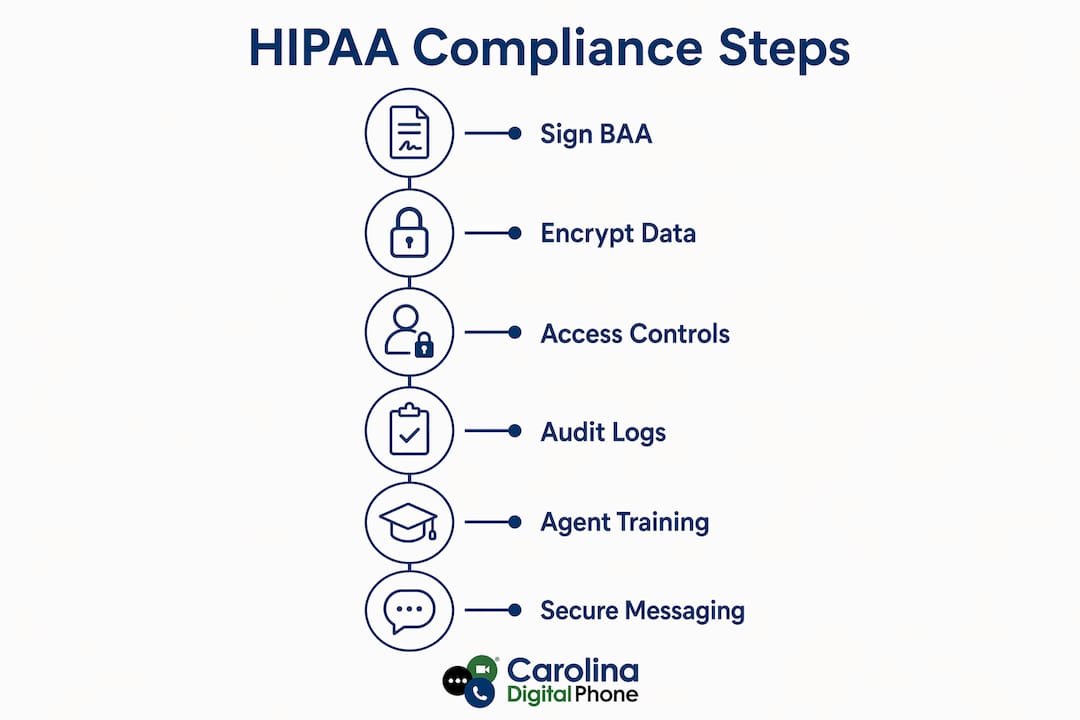
And people. Every safeguard above is operated by a human being who was either trained well or wasn't. Serious services put agents through substantial structured training (some advertise 80 hours or more before an agent ever handles a live patient call) plus annual refreshers as rules and internal protocols shift. When you evaluate a vendor, ask what their training program covers and when it was last updated. The pause before the answer tells you plenty.
Sorting this out for your practice?
Carolina Digital Phone configures compliant phone systems for medical and dental offices across North Carolina, and we'll gladly talk through where an answering service fits alongside your phone infrastructure. Real engineers, straight answers.
Call (336) 544-4000How to verify a vendor instead of trusting one
"Are you HIPAA compliant?" is a question every vendor answers yes. It's almost not worth asking. What separates the real ones is documentation, so ask for documents:
- The standalone BAA, including how it handles subcontractors
- Their most recent risk analysis (the Security Rule requires one; a vendor who can't produce it hasn't done it)
- Encryption standards for stored messages and recordings, in writing
- Their breach response process and internal timeline
- A sample audit log, delivered within a day of your asking
- The outline of their agent training program and its last revision date
Third-party attestations help too. SOC 2 Type II reports and HITRUST certifications aren't required by HIPAA, but they mean an outside auditor has actually walked through the vendor's controls rather than taking their word for it. Which brings me to the single most important sentence in this article: there is no such thing as a government-issued HIPAA certification. None. When a brochure says "HIPAA certified," that phrase has no legal standing whatsoever. HHS doesn't certify anybody. Compliance lives in the BAA, the safeguards, the training records, and the logs, or it doesn't live anywhere.
One more decision worth making before you shop: what kind of service do you actually need? A message-only service takes the call, gathers the minimum, and relays it securely. A live nurse triage service works from clinical protocols, carries malpractice coverage, and can resolve urgent calls without waking your physician. Triage costs more and carries clinical liability; message-only costs less and pushes more decisions back to your on-call staff. Neither is wrong. Shopping for one while needing the other is.
What I've watched practices get wrong, and the ones that get it right
Forty-five years in this industry, and the pattern hasn't changed much: the practices that get burned treated the BAA as a checkbox. Signed it unread, never asked who the subcontractors were, assumed the vendor "handles all that." The assumption is the breach.
The practices that stay out of trouble aren't the ones spending the most. They're the ones with a quarterly habit: pull a sample audit log, confirm the BAA still matches reality after any platform change, make sure the new hire actually got the training. An hour a quarter. That's the whole secret, and almost nobody does it.
And a tell I trust more than any certification logo: the good vendors enjoy your hard questions. They'll walk you through the risk analysis and show you the portal without flinching, because they did the work and they're a little proud of it. The ones who say "don't worry, we handle everything" with no specifics are asking you to carry their risk. Decline politely.
Nicky Smith, Founder, Carolina Digital Phone
Where Carolina Digital Phone fits
We're not an answering service, and I won't pretend otherwise. What we build is the phone infrastructure underneath: hosted voice with encryption, audit-ready call handling, secure voicemail and messaging practices, and an AI receptionist option, configured for practices that answer to regulators. We sign BAAs, we document what we do, and when something needs fixing you call (336) 544-4000 and a North Carolina engineer owns it until it's done. That's been the arrangement for more than 25 years, and it's why medical and dental offices across the state trust us as their local source for telephone, messaging, and AI Receptionist services.
If you're pairing an answering service with a new phone system, or trying to figure out whether your current setup would survive the vendor questions in this article, start with our healthcare phone solutions page or just call. The consultation is a conversation, not a pitch.
Frequently Asked Questions
What is a HIPAA-compliant answering service?
It's an answering service that operates as a Business Associate under HIPAA: it signs a BAA before handling patient calls and backs it with administrative, physical, and technical safeguards, including encryption, unique agent logins, audit logging, and secure message delivery.
Is a BAA required before an answering service handles patient calls?
Yes. The BAA must be signed before any protected health information is processed. Operating without one is a HIPAA violation on its own, even if no breach ever occurs.
Does a vendor's "HIPAA certification" guarantee compliance?
No. There is no government-issued HIPAA certification, so the phrase has no legal standing. Verify compliance through the BAA, documented risk analyses, training records, and audit logs rather than marketing claims.
Can an answering service send patient messages by text or email?
Not by standard SMS or unencrypted email; both violate HIPAA for PHI. Compliant services deliver messages through encrypted portals or dedicated provider apps that require login and log every access.
What is the Minimum Necessary Rule for answering service agents?
Agents may access and share only the PHI needed for the task at hand, typically a patient's name, callback number, and the general reason for the call, and nothing beyond their role's requirements.